CMP Optimization: How Consent Rates Directly Impact Your CPMs
Since January 16, 2024, serving personalized ads to users in the EEA and the UK requires a CMP that Google has certified and that integrates with the IAB Transparency and Consent Framework. Switzerland joined the same regime on July 31, 2024. That gate turns a consent banner from a compliance obligation into a yield variable: every percentage point of consent rate decides which demand pool a slice of your European inventory can enter, and those pools clear at very different prices.
The mechanics run one level deeper than most dashboards show. A consent choice is not binary: the TCF string carries a signal per purpose, and Google treats specific purposes as hard requirements. Drop purpose 2 and the impression may not serve at all; drop purposes 3 and 4 and it serves without personalization or remarketing value. The levers that move consent rates are operational, not legal: banner speed, vendor list size, consent mode wiring and per-purpose measurement.
What the certified CMP mandate actually gates
In the May 2023 announcement, Google told every partner using AdSense, Ad Manager or AdMob that serves ads in the EEA or the UK to run a Google certified CMP that integrates with the TCF. The announcement dates to May 16, 2023, and enforcement landed on January 16, 2024 for the EEA and UK, with Switzerland following on July 31, 2024.
Google's consent management requirements spell out the eligibility rule behind those dates: only traffic processed through a certified CMP qualifies for personalized ads. Non-certified traffic can still qualify for non-personalized or limited ads where supported, which limits the damage but does not close the gap.
The practical reading is blunt. If your CMP is not certified, your personalized stream in those markets is gone, and what remains serves in the lowest-price formats open to you. Certification is table stakes; the operational decision comes after it.
One distinction keeps getting lost in implementation tickets: certification covers the CMP platform, not the configuration you run on it. Layout, speed, vendor list and copy stay your decisions, and they decide the consent rate that the certified platform earns. Treat the certificate as the entry ticket and your configuration as the yield work.
For agencies advising several publishers, the mandate also created a portfolio benchmark: comparing consent rates across clients shows which banners underperform, and that underperformance is revenue, not paperwork. A per-client consent rate table takes an afternoon to assemble and ranks the fix list for you.
Purpose by purpose: what each consent signal is worth
The TCF string records consent per purpose, and Google maps those purposes to concrete eligibility outcomes. Google's TCF integration reference documents the mapping: Google does not use flexible registration for purposes 1, 3 and 4, and it always requires consent for those three.
- Purpose 1: store and access information on a device. This signal is the floor for cookies and device-level identifiers.
- Purpose 2: ad selection. If the string lacks purpose 2, the ad may not serve at all.
- Purposes 3 and 4: create and use personalized ads profiles. Without them, events lose eligibility for ads personalization and remarketing lists.
Walk a full rejection through that map. The session still generates a bid request, but the string excludes purpose 2 along with 1, 3 and 4, so Google demand either serves a fallback format or serves nothing. A user who consents to purposes 1 and 2 but declines 3 and 4 keeps the impression serving while personalization and remarketing eligibility disappear. Note that the framework allows legitimate interest as a legal basis for some purposes, but Google requires consent for 1, 3 and 4 regardless, so no legitimate-interest path rescues that demand.
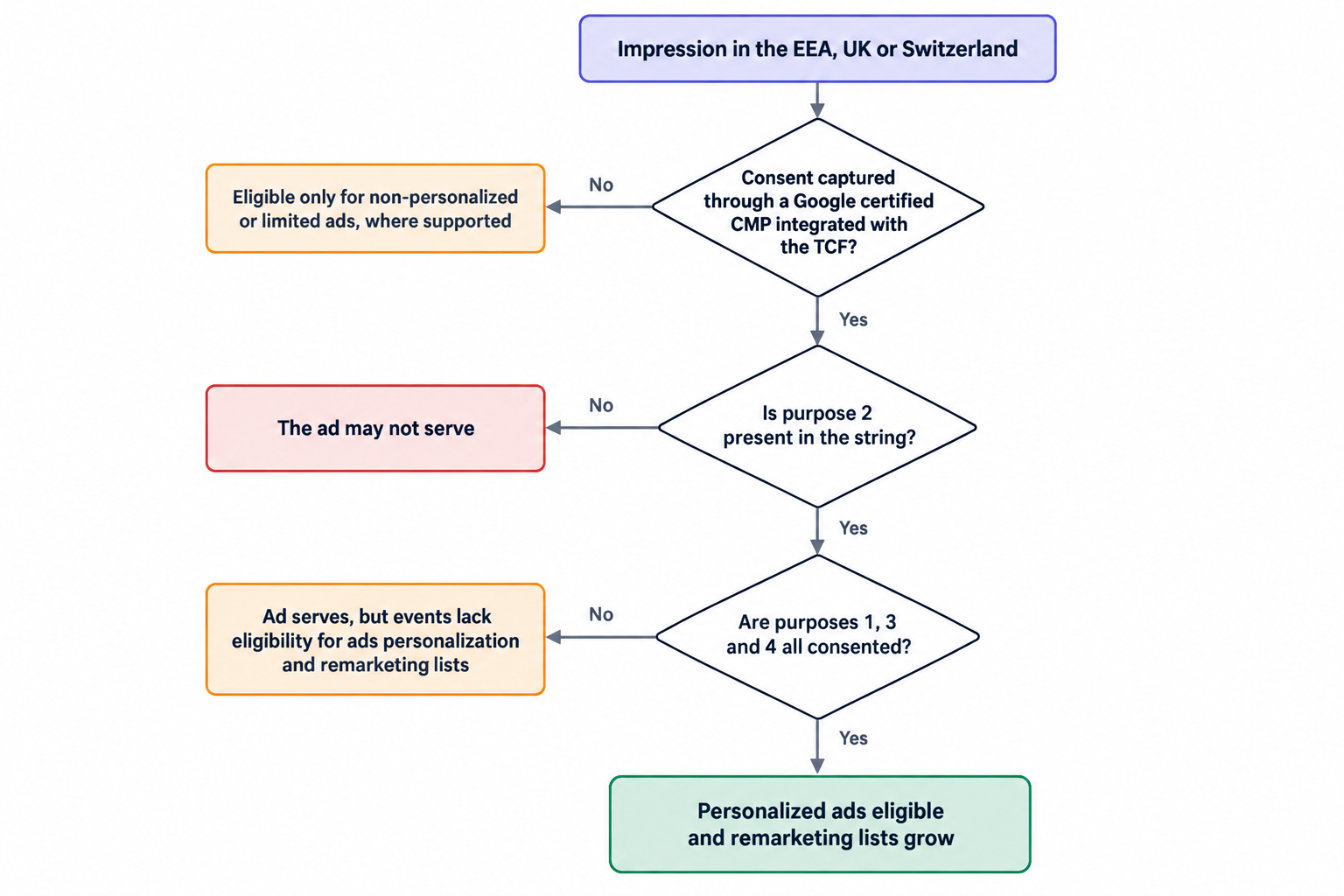
Those outcomes split consent reporting into three rates, not one. Track the purpose 2 rate, which decides whether the ad can serve; the purpose 1 rate, which decides whether a buyer can store anything on the device; and the combined purposes 1, 3 and 4 rate, which decides full personalization eligibility. A headline accept rate blends the three and hides the differences between them.
The GDPR-era numbers behind the price gap
A 2018 study from the first months of GDPR, reported in the trade press, gives the bands shape, with the caveat that its numbers are dated and directional rather than current benchmarks. Sites that implemented a CMP earned CPMs 52 percent higher than publishers that kept their existing setup. Publishers serving no targeted ads watched CPMs fall 43 percent in the two months after GDPR took effect, and their fill rates dropped 34 percent over the same window. Publishers using a CMP saw CPMs rise 9 percent and fill rates climb 5 percent post-GDPR.
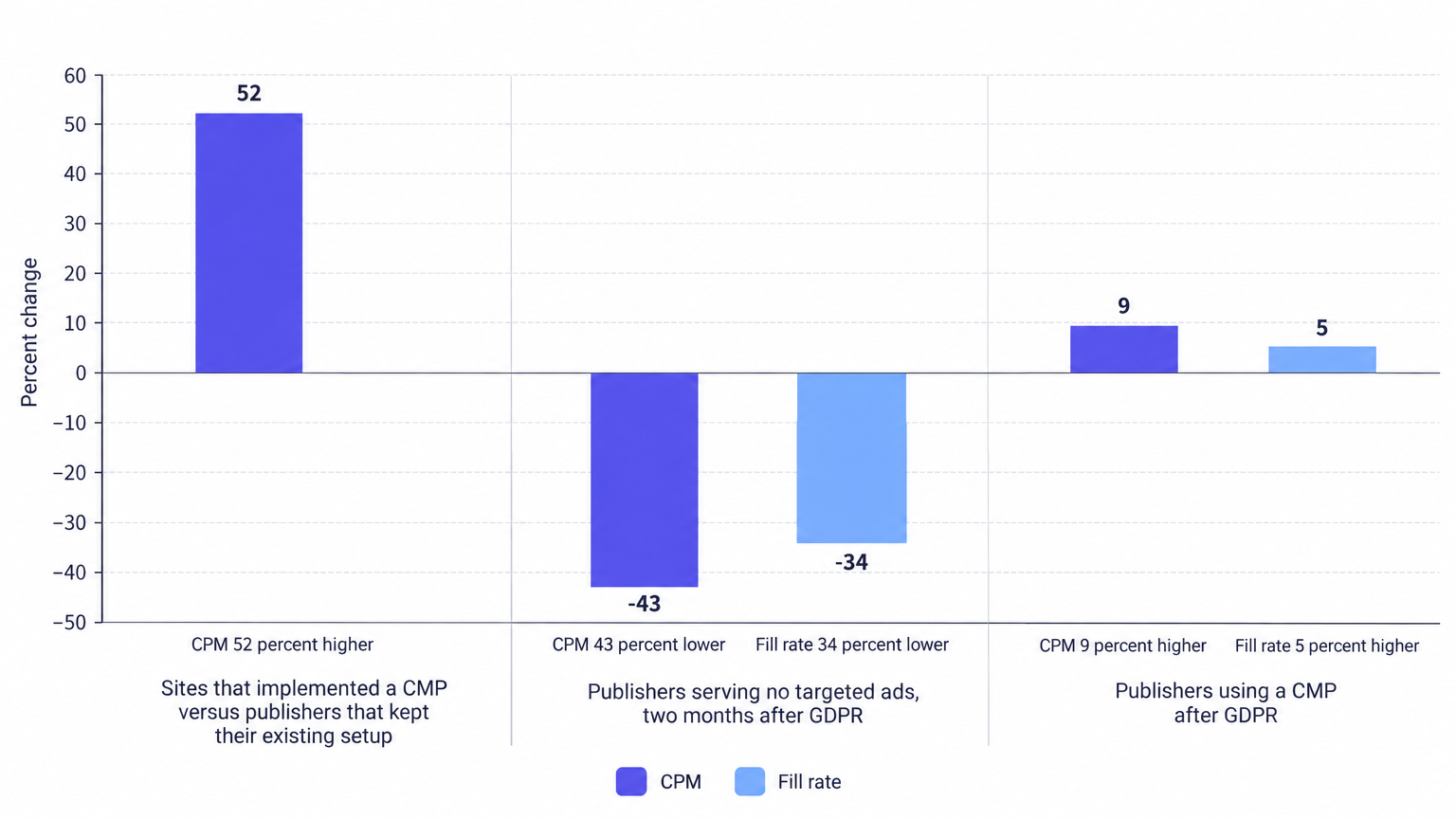
The market has repriced since 2018, but the direction holds, and the direction carries the argument: consent gates both fill and price. The fill collapse matters as much as the CPM collapse, because it shows the effect reaching the request level: inventory that stops matching buyer criteria stops receiving bids, not just cheaper ones. Purpose 2 consent protects whether an impression serves at all, and purposes 3 and 4 protect what a buyer pays for it and whether your remarketing audiences keep growing.
Consent rates are the weights in your blended CPM
European eCPM is a blend, and consent rates set the weights.
Blended eCPM = (full personalization share × personalized CPM) + (serving-eligible, non-personalized share × non-personalized CPM) + (limited share × limited CPM)
The formula assumes purpose 2 consent; where purpose 2 is absent, the impression may not serve and its term is zero. Run the sensitivity once and consent rate earns a permanent dashboard seat. One point of personalization consent moves one percent of impressions up a band, and the value of that point equals the gap between your own personalized and non-personalized CPMs, divided by a hundred. The same arithmetic on purpose 2 consent has a harder edge, because the downside there is not a lower price but no fill at all.
The auction layer amplifies the signal. In first-price auctions with bid shading, each buyer forms an expected value before bidding, and an addressable impression supports a higher one, so the buyer shades less and clears higher. Reserve prices and expected-value ranking then act on a bid distribution that consent state has already reshaped. Treat consent rate as an input to your auction, because it is one.
Consent mode keeps denied sessions measurable
Consent mode adjusts Google tag and SDK behavior based on the user's choices. When storage consent is denied, consent-aware tags send cookieless measurements, and Google Ads and Google Analytics model conversions from those pings. The same signals drive SDK behavior in apps and tag behavior on web. Four types control the adjustment: ad_storage for advertising cookies, analytics_storage for analytics cookies, ad_user_data for sending user data to Google for advertising, and ad_personalization for remarketing-style use.
Implementation order matters. Set the four types to denied by default, then let the CMP's TCF callback update them once the user acts. Wired in that order, denied sessions stay inside the modeling loop and refused traffic keeps feeding learnings to the campaigns running on your inventory. Skip consent mode and your refused traffic vanishes from performance reports. Inventory that stops reporting performance eventually loses the budget that performance reporting justifies.
The Additional Consent string most setups drop
The Additional Consent specification carries consent for Google ad tech providers that are not on the TCF Global Vendor List, alongside the TCF v2 string. In apps, the SDK stores the value under the key IABTCF_AddtlConsent. Two checks cover the gap: confirm your CMP emits the string on web, and confirm the app reads IABTCF_AddtlConsent before the first ad request fires. When the string is missing, those providers hold no consent record for the user, and the fix lives in CMP configuration, not in legal review.
Where the string travels
Knowing the pipe keeps debugging fast. The CMP builds the TCF v2 string on the device; Prebid's consent management module reads it and stamps every outgoing bid request with the GDPR flag and the consent string; our OpenRTB 2.6 seats forward the same signals to buyers, who score them per purpose. Server-side hops must forward the same fields, and wrappers differ in what they preserve at that hop, so log one outgoing request and read the actual payload before trusting the configuration. If any hop drops the string, a buyer sees an EEA impression with no consent record and treats it accordingly.
How buyers read your consent state
We run an ad network, an SSP and an agency under one roof at OnlyMedia, so we watch consent behavior from both ends of the bid stream. Our OpenRTB 2.6 seats and our Prebid header and server-side integrations pass consent state with every request, and the campaigns our agency plans read the same state when they choose inventory. Demand partners reach verified audiences through curated supply paths, and consent state decides whether those audiences resolve at all: a buyer with an audience target cannot match it to an impression that carries no consent for the matching signals. Faced with two packages that match on format and viewability, the buyer takes the one with complete consent signals and a live measurement loop. Consent rate is part of your pitch to demand, not just a file in your compliance folder.
The consent-rate playbook
Raising consent rates inside honest choice is a design and engineering problem, and the levers are unglamorous. Across the thousands of publishers above one million monthly pageviews we work with, a few practices separate the best banners from the rest.
- Cut banner latency below your ad calls. Load and execute the CMP before any bid request fires; a session that bounces before the banner renders produces neither consent nor revenue.
- Trim the vendor list. We filter our list to partners that actually transact on our supply, because every extra vendor adds script weight and reading time, and a shorter list builds the string faster.
- Give reject parity with accept. Same prominence, one click each, plain-language labels. Consent won through clarity compounds; consent won through friction does not survive scrutiny.
- Layer the interface. Keep the first layer to a short statement of what data is collected and why; hold the toggles and the full vendor list in the second layer.
- Segment every number. Report consent rate per purpose, per geo, per device and per banner version, because the headline accept rate hides the three rates that matter.
- Test on a cadence. Run copy and layout variants at least quarterly, and regression-test after every CMP release.
None of these levers rely on trickery, which is the point. In a certified-CMP market, the durable way to raise consent rate is to make the honest choice fast and easy.
Failure modes that eat consent rate silently
Most consent rate regressions we diagnose trace back to one of five patterns. Each one leaves the banner looking fine while the signal never reaches the buyer.
- Race conditions between banner and ad calls. Bid requests that fire before the string exists reach buyers with no consent signal. Gate every ad call, header and server-side alike, on the CMP callback.
- The wrong denominator. Sessions that never render the banner, including bots and fast exits, drag a naive accept-rate metric down and hide real gains. Define consent rate per purpose over sessions that rendered the banner.
- Switzerland outside the country list. A stack that shows the CMP only to EEA and UK traffic has served Swiss traffic without consent collection since July 31, 2024, and that traffic then falls back to non-personalized or limited formats.
- App and web divergence. The web string can look clean while the app drops the Additional Consent value, so read IABTCF_AddtlConsent in your app telemetry before assuming parity.
- Vanity accept rates. Custom toggle paths produce mixed strings; only per-purpose reporting shows how much of your accepted traffic actually carries purposes 3 and 4.
Check them in that order, cheapest diagnosis first. A request log answers the first one immediately, and the rest need nothing more exotic than split reporting.
Run consent rate like any other KPI
Put three purpose-level rates on the daily dashboard next to viewability and invalid traffic: purpose 2 consent rate, purpose 1 consent rate, and the combined purposes 1, 3 and 4 rate, each split by geo. Review them weekly and treat a drop as an incident, because template changes bury banners and CMP releases alter layouts without asking. Read consent rate against revenue per session rather than raw CPM, since the blend shifts with the consent mix.
Measurement holds the system together. Our publisher monetization console refreshes every ten minutes and shows consent rate beside fill and viewability, so a banner regression surfaces as a revenue event within the day instead of in a quarterly legal review. We pay Net 30, CPM based, no chasing and no sliding terms, and our curated programmatic demand network works with publishers above one million monthly pageviews, the scale at which single points of EEA consent rate carry real money each month.
A certified CMP keeps your inventory eligible for the market. The consent rate you earn on top of it decides what that eligibility clears at.