Google Ad Manager 360 vs. GAM Small Business
Google gates the free tier of its ad server at one million monthly pageviews tied to an approved AdSense account, and that same number marks the point where the free tier stops being the obvious choice. A property above one million monthly pageviews clears the qualification bar on traffic alone, so eligibility is not the decision. The decision is posture: a standalone Small Business network, a paid Ad Manager 360 property, or a Small Business account managed as a child under a 360 parent. All three run the same ad server and the same auction, so the comparison turns on what surrounds the auction: who manages whose inventory, what the contract costs, where fees hide, and what reporting you control.
One auction engine, two price tags
The product line has consolidated twice, and both consolidations frame the tier decision. Google announced the original Ad Manager on March 13, 2008 on its Inside AdSense blog, shortly after it completed the DoubleClick acquisition that March, and presented it as a commitment to provide publishers of all sizes with tools to improve revenue opportunities and productivity. On June 27, 2018, Google combined DoubleClick for Publishers and DoubleClick Ad Exchange into one product named Google Ad Manager. The deeper consolidation came in May 2019, when Google announced the unified first-price auction and rolled it out during 2019: the old second-price RTB auction and the separate first-price comparison folded into a single auction.
The 2019 change matters most for tier selection. Before it, platform choice carried auction consequences, because second-price dynamics lived in one place, first-price dynamics in another, and header bidding layered its own bid-shading problems on top of both. After it, both tiers run one unified first-price auction against every impression. A 360 contract does not buy a stronger auction, and Small Business does not serve a weaker one.
Two further consequences of unification apply to both tiers identically. AdX versus the ad server stopped being a product decision in 2018, because exchange demand now serves inside Ad Manager, which turns the operative question into which account configuration exposes that demand to a given property. And the unified auction moved the daily work to floor discipline on the sell side and bid shading on the buy side, work that both tiers face the same way. Tier selection inherits none of it.
Read the 2008 framing against that history and the tier question shrinks to its real size. Google's original pitch promised publishers of all sizes the same class of tooling; the 2018 unification delivered one engine; the 2019 auction unified the economics. What remains different between Small Business and 360 is commercial scaffolding: contracts, account management, and who may parent whom. That is where every dollar of difference between the tiers now lives, so that is where this comparison spends its time.
Small Business: the qualification is the story
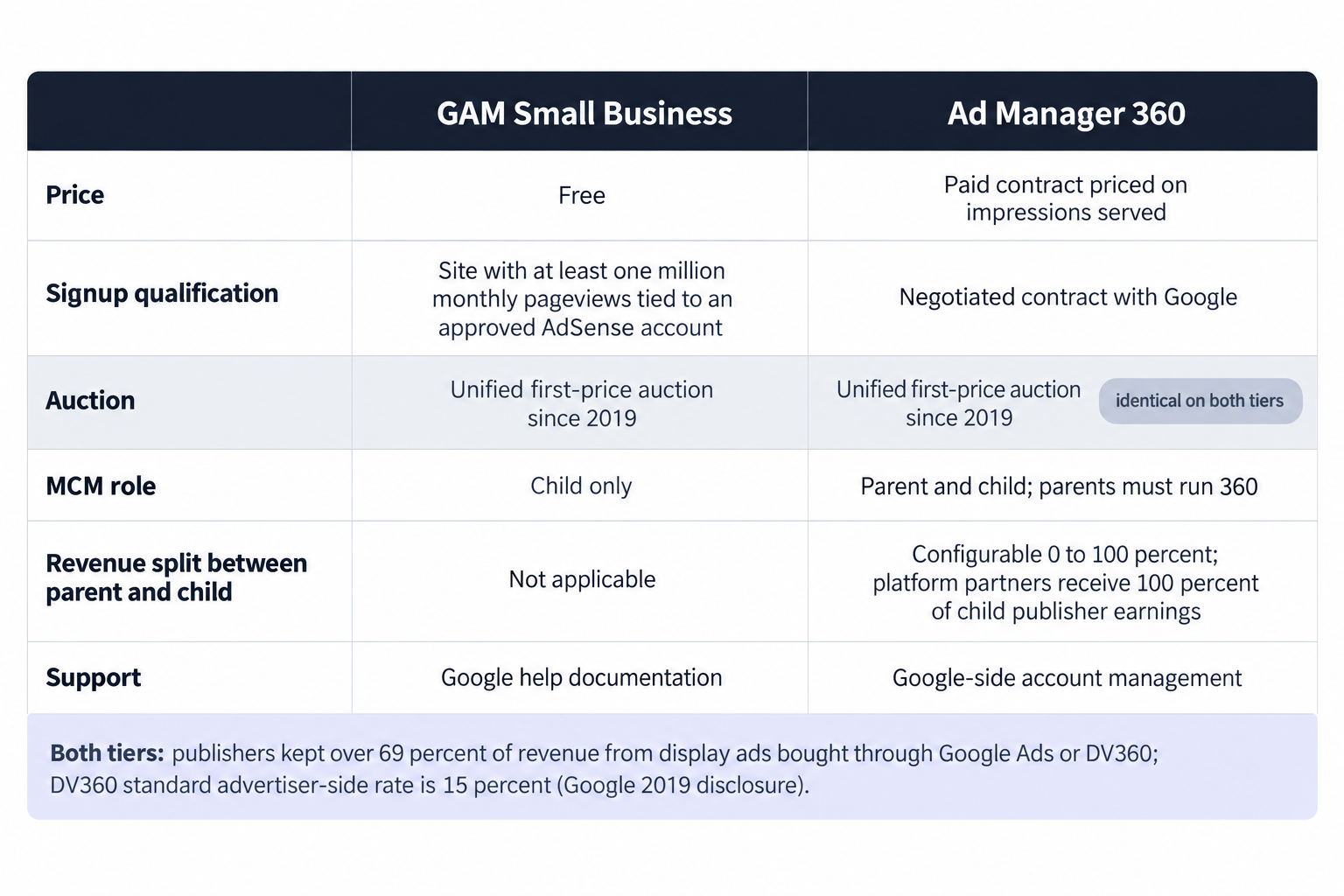
Ad Manager Small Business is free, and Google states the signup qualification plainly: a site with at least one million monthly pageviews tied to an approved AdSense account. The Small Business solutions page carries both the free-tier positioning and that bar, and the exact wording deserves a read before any tier conversation with a client.
Two operational details sit inside that sentence. First, the AdSense tie is structural, not incidental: the free tier rides on an approved AdSense account, so identity, payment and policy checks run through AdSense infrastructure before an Ad Manager network exists. Second, the one million pageview floor means Small Business is not a starter product in practice. A publisher at that scale has real seasonality, multiple demand paths and usually a direct pipeline worth trafficking. The free tier includes the full serving workflow: orders, line items, targeting, key-values, delivery controls and reporting. What it does not include is a parent seat, and that omission defines the rest of this comparison.
One question precedes the tier question. Google maintains an official comparison of Ad Manager and AdSense, and it is the correct entry point for stack selection: a property monetizing only through run-of-network demand, with no direct deals, no mediation and no trafficking, belongs in AdSense and should not absorb ad server operations at all. Everything that follows assumes the property needs an ad server, which at one million pageviews with mixed demand is almost always the case.
What the 360 contract adds
Ad Manager 360 is a paid contract, priced against impressions served and negotiated with Google rather than published as a rate card. Three structural differences separate it from the free tier.
First, Multiple Customer Management. Google restricts MCM to Ad Manager 360: the managing parent publisher runs 360. A child publisher can have one Manage Account parent and up to 15 Manage Inventory parents. Manage Account hands the parent the keys to the child's account; Manage Inventory leaves the child in control of its own account while granting the parent named inventory to monetize. The ceiling on Manage Inventory parents is an underused lever, because a child can delegate different slices to different parents and compare them on live traffic. Parent and child configure the revenue split anywhere from 0 to 100 percent, and under the platform partner model, Ad Manager 360 platform partners receive 100 percent of child publisher earnings through Google, with the commercial agreement between parent and child setting the payout. Read the split dial as a business model selector: a parent can pass demand through with no take, share a fixed percentage, or collect everything and pay children on its own terms.
Second, account operations. The 360 contract adds Google-side account management, while Small Business support runs through Google's help documentation. Feature deltas between the tiers concentrate on large-team operations, sales workflow and forecasting depth, and they shift release by release. Anchor the decision on the structural gates that do not move, and treat any feature matrix as a document that will date within months.
Third, eligibility asymmetry, which explains the entire parent market. Any qualifying publisher can open Small Business; 360 requires a contract. Publishers who want 360-grade monetization without the 360 invoice therefore run as MCM children under a parent that holds the contract. That is the setup many properties above one million monthly pageviews operate, and it deserves the same scrutiny as the contract tier itself.
Where the money actually moves
The free tier costs nothing on the invoice line, and that is not the same as free. Google's own 2019 disclosure quantified the transaction: publishers kept over 69 percent of revenue from display ads bought through Google Ads or DV360, and DV360 charges advertisers a standard 15 percent rate. The remainder covered fees across Google's buy side and sell side. None of it shows up on a Small Business statement; it lives inside the CPM the auction returns.
Each posture carries a different fee shape. Small Business has embedded transaction fees and no invoice. Ad Manager 360 adds explicit impression pricing on the contract. An MCM child carries the same embedded fees plus the parent's share, which the two sides set anywhere from 0 to 100 percent, or the platform partner construct where the parent collects 100 percent through Google and pays the child commercially. Negotiating with a parent therefore means negotiating one variable: where on that dial the relationship sits, and what the parent does to earn its share.
Run the comparison as three numbers against a month of delivery: the embedded transaction take, the parent's split, and any 360 impression pricing. Two rules keep the math honest. A zero split with a weak demand stack earns less than a meaningful split with a strong one, so evaluate any split against fill rate and CPM, never alone. And a parent that quotes a split without quoting reporting access is quoting half the deal, because undetected delivery failures cost more than any reasonable split over a quarter.
The child setup, with our terms on the table
The split dial is where child publishers lose money quietly, so we state our position on every element of it. We are an ad network, an SSP and an agency in one company, and we work with thousands of publishers, each above one million monthly pageviews. On the supply side, OnlyMedia runs Google Ad Manager, AdX and MCM for publisher partners and integrates OpenRTB 2.6 seats and Prebid for header and server-side demand. Our SSP runs one unified auction per impression: AdX via MCM, Prebid, managed floors. Our auction ranks bids by expected value, first price with bid shading, reserve prices, goal-based pacing, and we publish our auction mechanics rather than asking anyone to bid into a black box.
Payout is Net 30, CPM based: no chasing, no sliding terms. The entry bar matches the Small Business qualification, publishers above one million monthly pageviews, and the demand and payout terms behind our curated programmatic demand network sit in public before anything gets signed. Manage Inventory keeps your own direct deals and house lines intact while the parent monetizes the delegated slices, so the switch costs you trafficking control only under a Manage Account relationship. A parent unwilling to put split, payout schedule and reporting access in writing is telling you what the relationship will feel like in month six.
Reporting: the access a child must demand
Reporting is where the child setup fails most often, so make access contractual rather than assumed. A monthly statement from a parent is a receipt, not operations. Ask Ad Manager will raise the bar here. On June 18, 2026, Google announced Ask Ad Manager, a multi-turn conversational agent built with Gemini that helps publishers get deeper insights using only their own data: diagnosing and resolving delivery issues without interrupting workflows, pulling custom metrics and complex reports from a single prompt, and pointing to the right settings with context-aware links. The beta began that month, and the Ask Ad Manager announcement also details the developer roadmap: REST APIs and an MCP server for developers later in 2026.
Two consequences follow for tier planning. The agent works only with your own data, so the hygiene of your own Ad Manager network, clean line item naming, consistent key-values, a delivery history worth querying, determines what it can diagnose. And the MCP server will let internal tooling query Ad Manager directly, which resets expectations for what a parent or agency should expose to a publisher as standard practice.
We hold ourselves to a refresh standard for the same reason. Our reporting console refreshes every metric every ten minutes: CPM, fill rate, ad requests, pageviews, revenue, countries, devices and video detail, with API access so your own dashboards query ours directly. Ten-minute granularity exists to catch failure modes that monthly reporting cannot see: a muted ad unit, a pacing miss on a guaranteed deal, a header bidding partner dropping bids after a config change. A parent that cannot offer at least that cadence, in writing, asks you to monetize blind and settle monthly.
Two dates for the 2026 calendar
Ask Ad Manager is one of two dates worth tracking this year. The other: Programmatic Guaranteed overdelivery reconciliation with DV360 starts November 2, 2026. If you sell PG to DV360 buyers, audit pacing settings, guaranteed floors and billing workflow before that date, because overdelivery beyond the impression goal will start reconciling with the buyer then. Accounts running 360 direct should raise it with their Google account management; children should raise it with their parent, because a parent's pacing error lands on the child's revenue line either way.
Choosing: three questions, then one
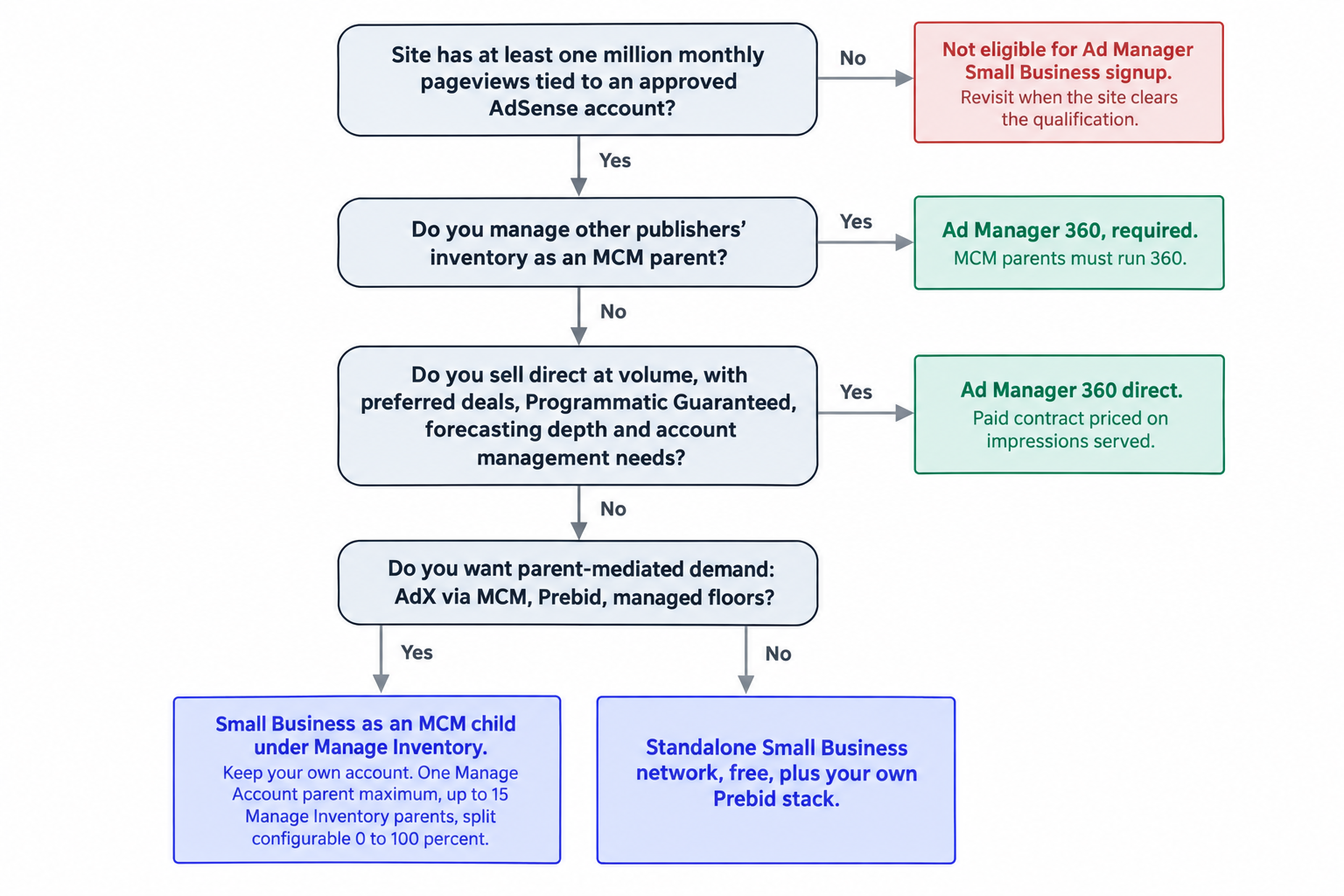
Three questions sort almost every account into the right setup, and the order matters because each one ends the analysis for some accounts. First: does the company manage other publishers' inventory? If yes, the decision is over, because MCM parents must run 360, so sign the contract. This is the only mandatory case.
Second: does the property sell direct at volume? A sales team trafficking preferred deals and Programmatic Guaranteed at scale, needing forecasting depth, negotiated terms and account management, usually finds the 360 contract cheaper than the drag of working around the free tier's limits. Run the math on impressions served against the hours your ad ops team spends compensating for what the free tier leaves out.
Third: everyone else runs Small Business, and answers one more question: does the property need parent-mediated demand, managed floors and a unified auction across AdX and Prebid? If yes, add MCM parents under Manage Inventory, keep your own account, and negotiate the split and reporting access hard. If no, run standalone, because the free tier plus your own Prebid stack is a legitimate production setup at any traffic level.
For agencies advising publishers, the audit list is short but consequential, and it applies before any tier recommendation. Check which parent holds Manage Account, since a child can have only one. Check where the split sits on the 0 to 100 dial and what the parent delivers for it: AdX via MCM, Prebid seats, managed floors, or a repackaged version of demand the publisher already had. Check reporting access, refresh cadence and whether the parent commits to exposing the Ask Ad Manager APIs when they land. Check payment terms: Net 30 on a CPM basis, or something with a chase clause and a sliding definition of revenue. A parent that answers all four in writing is worth its split; one that answers three of four will cost more than the split over a year.
If you want the split math run against your own inventory, request a revenue estimate by email. The numbers come back under the terms stated throughout this piece: Net 30, CPM based, one unified auction per impression. The auction engine is the same in every setup described here. The terms are not, and the terms are the whole decision.