How Agentic AI and Automation Are Transforming Ad Ops Workflows
AAMP v3.0 shipped from IAB Tech Lab on September 22, 2026, and its OpenProposal feature does one concrete thing: it turns the RFP-to-buy process, which most publisher sales teams still run over email and shared spreadsheets, into a standardized exchange between software agents. That change reaches further than any chatbot demo, because the RFP is where inventory gets priced, and it consumes the hours your team cannot bill to anyone. For sites above one million monthly pageviews the question is no longer whether agents will touch ad ops. It is which workflows you hand over first, and under what guardrails.
Where automation ends and an agent begins
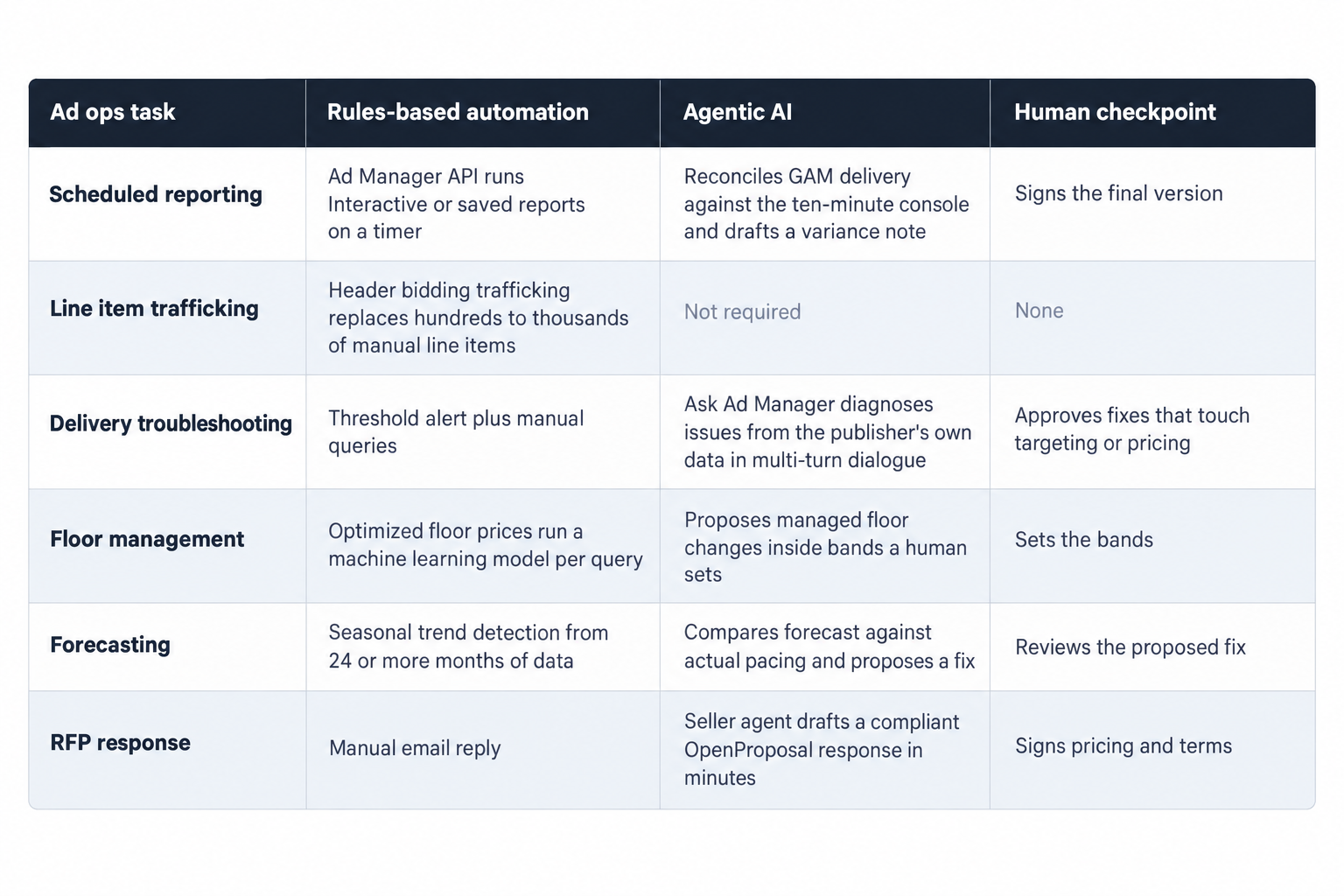
Ad ops has run on automation for a decade, so it pays to draw the line precisely. Header bidding trafficking in Ad Manager already eliminated the hundreds to thousands of line items publishers previously managed by hand. Google's optimized floor prices already run a machine learning model per query to maximize long-term revenue. The Ad Manager forecasting engine already detects seasonal trends from 24 or more months of data and applies them to future forecasts. These systems execute fixed rules or trained models, and they stop when the rule ends.
An agent is different in kind. You give it a goal rather than a runbook. It plans steps, calls tools such as report APIs and settings endpoints, reads the results, revises the plan, and reports what it did.
Google's Ask Ad Manager announcement landed on June 18, 2026, with the beta opening that same month, and it is the example most publishers will touch first. The agent is multi-turn and conversational, Google built it with Gemini, and it works only on the publisher's own data. It diagnoses and resolves delivery issues without interrupting existing workflows, pulls custom metrics and complex reports from a single prompt, and navigates to the right settings with context-aware links. REST APIs and an MCP server for developers follow later in 2026, and that release deserves the most attention: MCP is the protocol pattern that lets an agent call external tools in a standard way, so your own automation can gain the same reach as the vendor's assistant.
The distinction matters because the two fail differently. A script fails loudly: the job throws an error, the report never arrives, someone notices by noon. An agent fails quietly: it states a wrong number with full confidence and moves on. The guardrails later in this article exist for that second failure mode.
There is also a second reason this moment differs from earlier automation waves. The old automations required someone to anticipate the failure and write the rule in advance. An agent reads context: it can look at a line item's history, a delivery curve, and a settings page it has never seen, and produce a reasonable next step without anyone having scripted that step. That property is why the same technology covers delivery triage, deal response, and floor tuning, three tasks that resisted rule-based automation because every case looks slightly different.
The standards layer is settling, on rails you already run
IAB Tech Lab's agentic advertising initiative gathers this work under one umbrella, and the release cadence tells you how fast it moves. AAMP v3.0 arrived on September 22, 2026 with Buyer and Seller Agent SDKs and the OpenProposal feature that standardizes the RFP-to-buy process. The Content Monetization Protocols, CoMP v1.0, shipped in March 2026 for monetizing content with large language models. Agentic Audiences v1.1 shipped in August 2026 as an open standard for agents to exchange identity, contextual, and reinforcement signals, and OpenRTB and Prebid now integrate it.
Each protocol maps to a workflow you already run. OpenProposal turns the RFP into structured data, so a seller agent can receive a proposal, check it against floors, brand safety rules, and forecast availability, and draft a response for human review. CoMP gives publishers a standardized way to declare the terms under which large language models may use their content, which turns AI licensing from a bespoke legal negotiation into something a curation policy can enforce. Agentic Audiences matters most in the near term because it rides rails you already operate: OpenRTB and Prebid integrate it, so the identity, contextual, and reinforcement signals agents need can flow through the bid stream instead of through a parallel pipe.
The SDK question is a build-versus-buy decision, not a standard in itself. Buyer and Seller Agent SDKs mean a publisher can expose an agent interface without writing one from scratch, but the policy the agent enforces, meaning floors, brand safety, and availability, still has to live somewhere you control. Vendors will offer agents. The durable part of the stack is the data and policy layer underneath them, which is why curation has become the strategic asset in this shift.
The standards picture has not settled, though. A February 17, 2026 Digiday report laid out the programmatic standards standoff: one camp builds new standards native to AI agents, IAB Tech Lab augments and adapts its existing standards through its agentic roadmap, and the extent to which the two frameworks are compatible or competitive remains unclear. There is a practical stance for a publisher caught in the middle of that. Build against the pieces that ride OpenRTB and Prebid, because they interoperate today no matter which camp wins. Abstract your agent workflows from either framework, so a shift in the standards race costs you configuration time, not re-engineering. For agencies, the open question is which systems in the stack will expose an agent interface first, and under which standard.
Five workflows to rebuild first
Not every task earns an agent. These five do, roughly in order of payback.
Reporting assembly
The Ad Manager API can create and run Interactive reports, run existing reports you built in the UI, and power automated reporting pipelines, which makes the reporting agent the right first project for most teams. Its job is not to replace the query. Its job is to replace the assembly: pull GAM delivery, pull the network console, reconcile the two, and hand a human a variance note that names which line items moved and why. One caveat belongs in the runbook: figures for still-delivering line items may change between runs, so the agent must snapshot numbers, label them provisional, and never overwrite yesterday's final with today's draft.
Our reporting console refreshes every metric every ten minutes: CPM, fill rate, ad requests, pageviews, revenue, countries, devices, and video detail, with API access. A reconciliation agent can close the loop between our numbers and GAM's hourly instead of monthly, which turns the discrepancy conversation from blame allocation into bug fixing. The output stays a draft until a person signs the final version for a client or a finance meeting.
Delivery triage
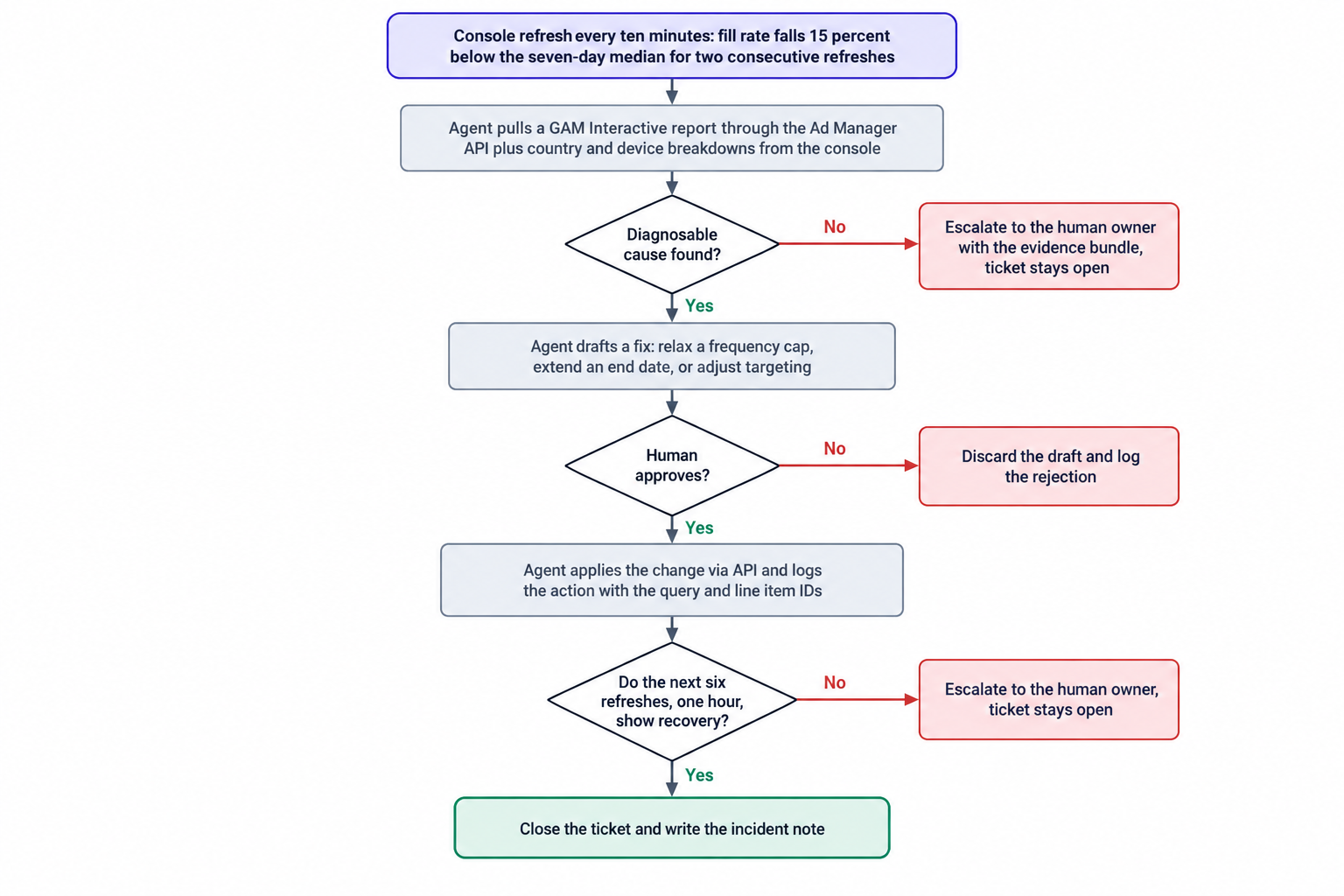
Delivery triage is the second candidate, and Ask Ad Manager already does a version of it inside the ad server. Before agents, this workflow meant a threshold alert, an open query tab, and a person guessing which setting moved. The agent reads forecast against actual and checks the usual suspects: targeting conflicts, exhausted frequency caps, creative approval states. Google's forecasting engine detects seasonal trends from 24 or more months of data and applies them to future forecasts, which gives the agent a baseline worth trusting.
Set explicit escalation thresholds instead of trusting agent judgment on novelty. A workable rule: flag any ad unit whose fill rate falls 15 percent below its seven-day median for two consecutive ten-minute refreshes, then have the agent assemble an evidence bundle and route it to a human. Its fixes should sit in a narrow menu: relax a frequency cap, extend an end date, or adjust targeting. A person approves anything that touches targeting or pricing, and then the agent monitors the next six refreshes, one hour of data, before the ticket closes with a short incident note.
Floor and yield management
Floor work is where automation and agency meet. Google's optimized floor prices already run a machine learning model per query, and publishers layer policy on top: we run managed floors, demand mapping, and whitelists in a curation layer that sits in front of the auction. An agent fits between the two. It can tune managed floors inside bands a human sets, propose structured tests, read the revenue result ten minutes later, and log what it changed. Our programmatic page documents the auction mechanics it operates against: expected-value ranking, first-price with bid shading, and reserve prices. Bounded autonomy works here. Full autonomy does not, because floor changes compound across the whole book.
Deal response
OpenProposal standardizes the RFP-to-buy process, and it reshapes deal workflows on both sides. Buyer agents will send more proposals, smaller proposals, faster, and evaluate responses against campaign goals rather than relationship history. A seller agent can ingest a proposal, check it against floors, brand safety, and availability, and draft a compliant response in minutes, with a human signing pricing and terms. If you advise publishers as an agency, the actionable audit is response readiness: can this publisher answer a structured proposal automatically, or does every RFP still route through one person's inbox? Over the next two years, response speed becomes a measurable advantage in won deals.
Quality control
Agents earn their keep fastest on quality, because anomalies are exactly what continuous pattern checking finds early. A country spike in ad requests, a shift in device mix, a domain pattern that resembles MFA, a fill rate cliff on one ad unit: each is a query away, and an agent runs the queries continuously instead of when someone remembers to look. Our curation layer already applies pre-bid brand safety filtering and MFA filtering aligned with the IAB Content Taxonomy before the auction, which gives an enforcement agent a policy to apply rather than a judgment to improvise. The taxonomy alignment matters on the buy side too: buyer agents screening against category exclusions read the same labels you publish, so a clean taxonomy export is now a revenue task, not a documentation task. Agentic Audiences adds a feedback loop here, because reinforcement signals tell a buyer agent which placements perform, and clean sell-side signals keep your inventory in that learning loop for the right reasons.
Guardrails that match the failure mode
Agents fail confidently, so the controls differ from the ones you use on scripts. Four rules cover most situations:
- Read-only by default. Every write goes through a proposal step where a human clicks approve.
- Log every action with the query, the line item IDs, and the numbers behind the claim, so any output can trace back to source.
- One named human owns each agent and reviews its log weekly, because accountability for a revenue report cannot sit with software.
- Consent travels with the signal. Agentic Audiences exchanges identity and contextual signals, and those signals carry the same consent obligations they carry in the bid stream today, so an agent deciding anything about a user in the EU reads the TCF consent string like any other component of the request.
There is also a judgment boundary that no protocol fixes. Sponsor conflicts, editorial sensitivities, a buyer who threatens to churn every year before Q4 renewals: those need a person who knows the account's history. Hand agents the assembly work. Keep humans on consequences.
Data hygiene decides what your agent is worth
Agents amplify whatever data quality exists, in both directions. A publisher with one source of truth for revenue gets an agent that drafts a defensible report in minutes. A publisher with three conflicting spreadsheets gets an agent that drafts a confident lie at the same speed. That is why the first agent project is plumbing, not prompting.
At OnlyMedia we run all three sides in one company, network, SSP, and agency, so we see agent workflows from the buy side and the sell side at once. We work with thousands of publishers, each above one million monthly pageviews, and we pay Net 30, CPM based, with no chasing and no sliding terms: our curated demand network page lists those terms alongside the entry bar. The about page covers who we are: expected-value auctions, honest pricing, and reporting both sides trust, and that last part matters most for agents, because reconciliation across two parties only works when both parties believe the numbers. A console that refreshes on ten-minute cycles and exposes the full delivery picture through an API gives a publisher's agent a second source to verify against, instead of taking the ad server's word for it.
For agencies the same logic applies in reverse. A buyer agent reading a publisher's signals forms its view of that inventory faster than any human planner did, and it will not accept a relationship call as a counterargument. Software reprices publishers whose data is inconsistent before anyone notices the negotiation happened.
A ninety-day rollout
Sequence matters more than tool choice. This is the order we recommend to publishers and agencies starting now.
- Weeks 1 and 2: inventory the repetitive tasks, then rank them by frequency times variance. Reporting assembly and delivery triage usually top the list.
- Weeks 3 to 6: fix the plumbing: API keys, consistent schemas, one definition of a pageview, one source of truth for revenue. An agent reading three definitions of a pageview produces three answers.
- Weeks 7 to 10: run a read-only pilot and measure the error rate the way you would measure a new hire's.
- Weeks 11 to 13: grant bounded writes behind approval gates: proposal responses, floor changes inside bands, frequency cap adjustments. Keep the kill switch one click away.
- Ongoing: one owner per agent, a weekly log review, and a quarterly decision on expanding or retiring scope.
None of this cuts headcount on its own. It moves the same people from assembly to review: the trafficker who spent Mondays pasting numbers into a deck becomes the person who checks the agent's variance note, which is better work and higher-leverage work. Plan the skill shift explicitly, or your best operator becomes the bottleneck.
Agencies advising publishers should run the same audit on client data before recommending any agent stack. The publishers who start with plumbing outpace the ones who start with prompts.
The pieces now exist end to end. AAMP v3.0 standardizes the deal workflow, CoMP v1.0 standardizes content licensing for language models, Agentic Audiences v1.1 moves agent signals over OpenRTB and Prebid, and Ask Ad Manager shows what an agent inside the ad server looks like at beta. None of it replaces the ad ops team. It changes the team's composition: fewer hours assembling spreadsheets, more hours deciding what the agents may do next. Treat an agent like staff, with a job description, boundaries, and a performance review, and it compounds. Hand over the keys without guardrails, and you will meet the quiet failure mode in the worst possible place, the revenue report.