Leveraging Audience Segmentation to Secure High-Paying Direct Deals
Advertisers whose campaigns leveraged one publisher group's first-party data were 37 percent more likely to run another campaign versus those whose campaigns didn't, a 2021 result Google published as an Ad Manager success story, and it is the strongest single argument for treating audience segmentation as a sales asset rather than a reporting feature. A premium on one campaign is revenue. A buyer who returns quarter after quarter because the audience performed is a business. Segmentation produces both at once: it raises what the auction pays for your impressions today, and it creates the product a direct buyer will guarantee budget against next quarter.
The work splits into three layers: the plumbing inside Google Ad Manager that turns visitor behavior into servable segments, the product decisions that decide which segments justify a rate card, and the pricing and sales mechanics that turn segments into signed deals. Most publishers finish the first layer, stall at the second and never build the third. The third layer is where direct budgets sit.
Why a named audience commands a premium
Open auction demand prices an impression: its placement, its content category, its viewability, its device, the hour of the day. Direct demand prices a population: a defined group of people whose volume the publisher can prove. Once a buyer can name the audience, the buyer stops comparing your inventory against every other impression in the auction and starts comparing it against the cost of assembling that audience anywhere else. That comparison is the whole basis of the direct premium.
The auction pays for signal work before you sign anything. Google reported that beta partners experienced an increase of 15 percent or more in programmatic auction revenue when passing PPIDs in inventory without other identifiers. A publisher provided identifier is a stable first-party key Ad Manager uses to recognize a returning visitor, hold frequency caps and assign segment membership, and it keeps working in inventory where third-party identifiers have thinned out. One asset, two returns: the auction pays more, and the segments become the direct product.
Exclusivity does the rest. A first-party segment draws on your readers alone, so a competitor cannot replicate it at any price; the best a rival can manage is an approximation through lookalike modeling, at lower accuracy and extra cost. Put that exclusivity in front of a planner and the negotiation stops being about rate discounts and becomes about access.
The plumbing: from visitor key to sellable segment
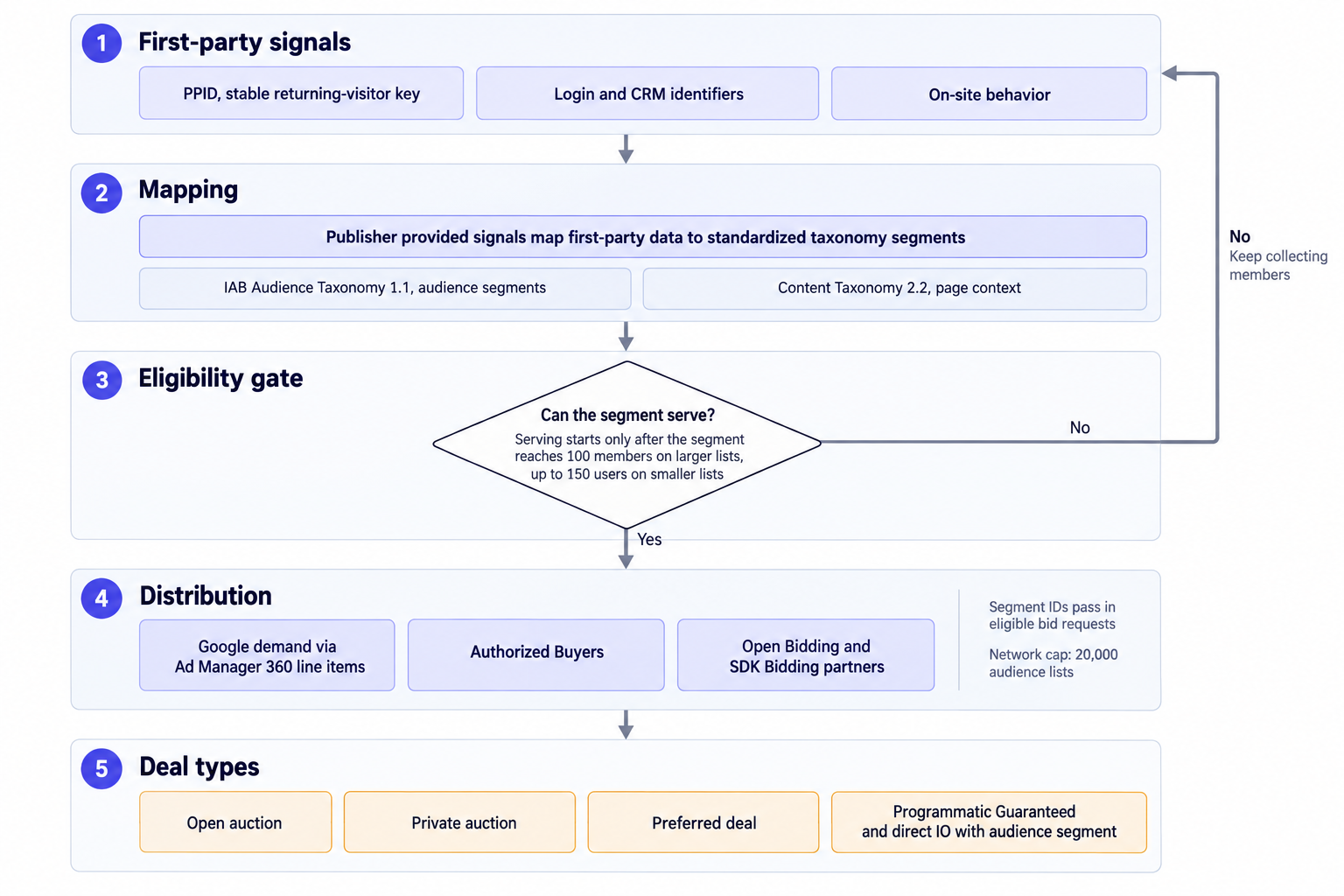
Start with a hard gate. First-party audience segments exist only in Google Ad Manager 360; a standard Ad Manager account cannot build them, traffic against them or forecast them. A publisher without a 360 license reaches the capability through a managing partner that holds one: at OnlyMedia we run Google Ad Manager, AdX and MCM for every publisher in our curated programmatic demand network, thousands of accounts, each above one million monthly pageviews, and the 360 segment layer comes with the stack rather than as an upgrade negotiation.
Serving floors come next, and they shape launch timing more than any other setting. Ad Manager serves a line item against a segment only after the segment reaches 100 members on larger audience lists, and on smaller lists the floor can run as high as 150 users. Build segments before the sales conversation, not during it: you cannot quote volume for a segment created the week of the pitch, and you cannot honor a guarantee against one either. Give every segment a data-gathering runway measured in weeks before it appears on a rate card.
Ad Manager also caps networks at 20,000 audience lists. For one publisher that ceiling is distant; for an MCM parent managing thousands of accounts it is a working budget. Treat lists accordingly: assign each account a list allowance, enforce a naming convention that carries the publisher prefix, the taxonomy ID and the recency window, and retire dead segments quarterly so the cap fills with sellable inventory rather than experiments.
Distribution runs through publisher provided signals. Publisher provided signals map first-party data to standardized taxonomy segments, and Ad Manager passes the segment IDs in eligible bid requests to Google demand and to eligible Authorized Buyers, Open Bidding and SDK Bidding partners, standardized to IAB Audience Taxonomy 1.1 or Content Taxonomy 2.2. The standardization is the commercial point: a planner at a DV360 seat or a Trade Desk seat recognizes an IAB Audience Taxonomy 1.1 ID without a custom translation layer, which shortens the path from pitch to trafficking.
Forecasting closes the plumbing. Availability checks let a publisher verify that an audience segment can serve on specific inventory before trafficking, and the estimates improve as segments gather data. Run the check before quoting volume, rerun it weekly until contract signature, and treat a wide early interval as a reason to quote conservatively rather than a reason to guess. A young segment forecasts badly, and the cost of a bad forecast lands on the publisher, not the buyer.
Building a catalog buyers pay for
Start from the money, not from the data. Pull the last several quarters of direct and near-direct demand and answer three questions: which verticals bought, which audiences did they ask for and not get, and which contextual packages cleared a premium. Build segments against those asks first, because those asks already carry budget.
Feed the segments from behaviors a buyer can picture. Content streaks, three or more articles in one category inside a recency window, produce intent segments. On-site search queries produce demand segments, and they sit closest to a purchase funnel of anything a publisher owns. Tool and calculator use, configurators, comparison tables and pricing pages mark readers nearest to a decision. Newsletter opens and logins mark readers with an identity you can hold across sessions, which is where frequency capping and PPID assignment earn their keep.
Structure the catalog in three classes, because each prices differently. Intent segments, readers actively researching a purchase, carry the highest premiums and the shortest shelf lives, so recency windows belong in days. Affinity segments, sustained interest in a category, hold mid-range premiums and renew well because their membership is stable. Broad contextual and demographic segments price closest to the open auction and earn their keep by filling guaranteed volume. Sell the recency window explicitly: auto intenders inside 14 days is a different product from auto intenders inside 180 days, and buyers pay for the difference.
Size discipline follows from the serving floors. A segment below 100 members cannot serve a line item at all, and a segment covering 80 percent of your traffic is not a segment, it is your traffic with a label on it. Keep the sellable catalog tight, a dozen to two dozen core segments per property, each with a named buyer category, a distinct rate and its own forecast. Overlapping segments cannibalize each other in forecasting and muddy the pitch.
Consent belongs in the build, not the cleanup. Under the IAB TCF framework, pass the consent string and honor it: traffic without a valid consent signal cannot serve personalized line items in the EEA and the UK, and the shortfall surfaces as underspend that takes weeks to diagnose. Content Taxonomy 2.2 provides the fallback, because the same deal can serve a contextual proxy segment wherever the personalized segment cannot fire. Write the fallback into the deal terms so the guarantee survives consent gaps.
Pricing the guarantee
A direct deal with an audience guarantee is a short position on your own traffic: you sell impressions you do not yet have, against a segment whose membership changes weekly. Price that risk explicitly.
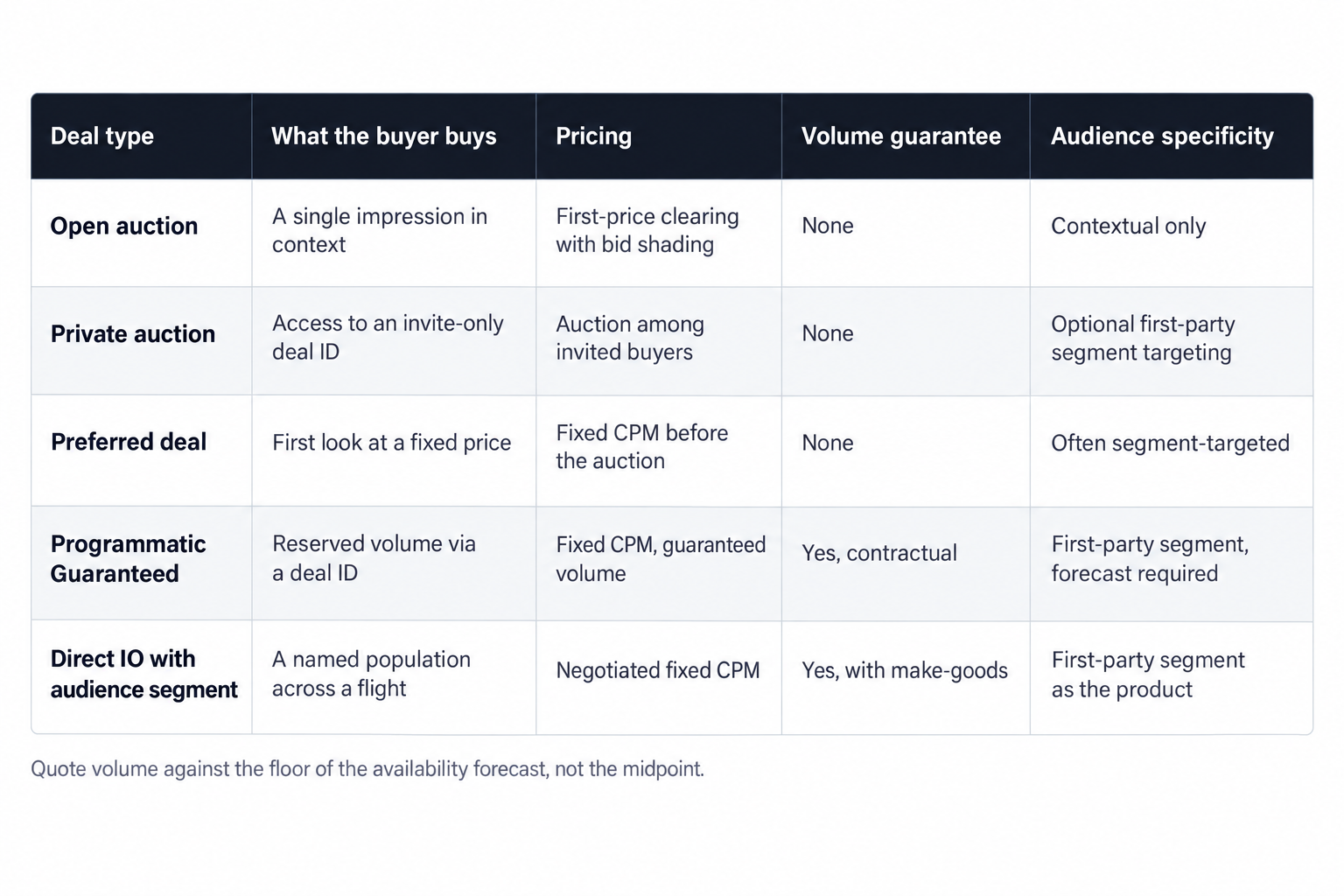
Work the comparison with hypothetical numbers. Take a segment of 400,000 monthly uniques generating 6.2 million monthly impressions. Assume the open paths clear those impressions at an effective $2.10 CPM: selling all 6.2 million into the auction returns $13,020 a month. Now carve 1.8 million impressions into a Programmatic Guaranteed deal or a direct insertion order at a $7.50 CPM, $13,500 of committed revenue, and let the remaining 4.4 million clear openly at the same $2.10, another $9,240. The structure returns $22,740, roughly 75 percent more than open-only, and it carries a make-good obligation the open path never asked of you.
Run the comparison on segment-specific eCPM rather than sitewide eCPM, because the deal flatters itself if the auction would have paid more for those impressions anyway. The mechanics behind that open-side number, first-price clearing with bid shading and expected-value ranking, sit in our auction mechanics and reserve prices primer.
Quote against the floor of the availability forecast, never the midpoint, and hold a buffer between committed volume and forecast floor. A make-good on a guaranteed audience deal costs more than cash: it costs the renewal. If the forecast floor cannot absorb the buffer, sell the segment through a preferred deal or a private auction instead, and let the segment mature for a quarter.
The pitch: what a buyer needs to sign
A direct buyer signs once the offer answers three risks: reach risk, will the audience be there at the promised volume; performance risk, will it convert; and operational risk, will the deal serve clean and report clearly. The pitch materials exist to close all three in one meeting.
Bring the following to the first call, one page per audience. Update every number before each follow-up meeting, because a stale forecast in the one document that proves reliability kills the pitch:
- Segment definition: the behavioral rule, the recency window and the IAB Audience Taxonomy 1.1 ID.
- Scale: monthly uniques, monthly impression forecast and the availability check behind both numbers.
- Delivery quality: viewability for the placements the deal will serve, the frequency cap policy and the brand safety posture.
- Terms: exclusivity scope, flight dates, make-good policy and the measurement plan for the post-campaign readout.
Package examples make the catalog concrete in the room. An auto intenders package, three or more vehicle reviews inside 14 days, sells against launch campaigns and model-year pushes. A travel researchers package, destination guides plus flight and hotel page paths inside 30 days, sells against booking windows. A B2B decision maker package, deep reads on one product category plus pricing page visits, sells against account based budgets that otherwise flow to social platforms.
A buyer reads this package as risk pricing, and a well-built sheet does half the negotiation before the call starts. A planner who sees the taxonomy ID, the forecast and the supply path in one pass moves to terms faster than one who has to reverse-engineer the offer.
On the buy side, planners score the same package against demand side reach, curated supply paths and verified audiences for OpenRTB 2.6 buying, the criteria our advertiser page spells out. Match your sheet to those criteria line for line, because every gap in the sheet becomes a discount in the negotiation.
We are an ad network, an SSP and an agency in one company, and OnlyMedia's agency side brings direct budgets and guaranteed deals to the same inventory the network monetizes. Those budgets arrive through DSP seats and agency direct lines, and they come backed by measurement studies, not cold outbound. That structure also settles the conflict question before a buyer asks it: direct line items take precedence in Ad Manager, and the segment layer is what makes that precedence worth the premium, because the direct buyer receives a population the open auction never sees whole.
After signature: pacing, make-goods, renewal
Delivery starts with the same availability checks that closed the deal, rerun at trafficking time, because a month-old segment forecast is a guess wearing a number. Pace weekly off the deal ID's delivery report, watch frequency caps so the guarantee does not compress onto a thin slice of heavy users, and hold the buffer until the final week of the flight. Underspend found in week three has a fix; underspend found in week twelve has a refund.
Report on the population, not just the delivery. A renewal meeting needs unique reach against the forecast, the frequency distribution, the share of impressions served against the segment versus its contextual fallback, and the post-campaign study the agency line ran. That study is the evidence the next negotiation stands on, so schedule it at signature rather than at campaign end.
The renewal case writes itself when the measurement plan runs on schedule. The 2021 success story cited at the start carries the renewal logic: advertisers whose campaigns leveraged one publisher group's first-party data were 37 percent more likely to run another campaign versus those whose campaigns didn't. Treat the post-campaign readout as the first meeting of the next campaign, with segment performance, the delivery report and the incremental audience the buyer has not bought yet on the table.
Settlement is the quiet differentiator. Direct budgets that arrive through our agency side settle on our publisher terms: we pay publishers Net 30, CPM based. No chasing, no sliding terms. A publisher carving premium impressions out of the open auction for a guaranteed flight should not wait on an agency AR cycle to see the money, and in our stack they do not.
The pipeline, end to end
Run the program as a pipeline with stages, owners and dates, because segmentation fails in the handoffs. The sequence below assumes a property above one million monthly pageviews with a 360 license already in place:
- Confirm Ad Manager 360 access and map first-party keys across the property, including logins, CRM identifiers and PPIDs.
- Build a dozen to two dozen core segments mapped to IAB Audience Taxonomy 1.1, with recency windows in the names.
- Clear the 100 or 150 member serving floors with weeks of runway before any sales conversation.
- Forecast with availability checks, quote against the floor, and hold a make-good buffer.
- Package the pitch materials and route the offer through the agency and DSP lines.
- Pace off the deal ID, measure on schedule, and convert the post-campaign readout into the next deal.
Each stage feeds the next, and the asset compounds: the identifier lifts the auction, the segments build the rate card, the rate card closes the guarantee, and the measurement study brings the buyer back. Above one million monthly pageviews, segmentation is the difference between selling impressions to whoever bids and selling audiences to buyers who return.