Optimizing Google Ad Exchange using First-Party Data Integration
On November 3, 2021, Google reported in November 2021 that beta partners passing publisher provided identifiers, or PPIDs, on inventory without other identifiers saw programmatic auction revenue increase by 15 percent or more. The same post carried a second finding that most summaries skip: PPIDs change nothing on inventory where third-party cookies or other identifiers remain available. Together, those two lines set the entire agenda for first-party data work in Google Ad Exchange. The lift lives in traffic that has already lost its identifiers, chiefly Safari and Firefox browsing and app webviews, and the plumbing has to exist before the last identifiers erode.
We are an ad network, an SSP and an agency in one company, and we run Google Ad Manager, AdX and MCM for thousands of publisher partners, each above one million monthly pageviews. We also integrate OpenRTB 2.6 seats and Prebid for header and server-side demand. Across that portfolio one failure pattern repeats: publishers treat PPID, key-value targeting, first-party audience segments and publisher provided signals as a single feature with four names. The four mechanisms carry different payloads, under different limits, on different clocks, and AdX monetizes each one differently. The sequence, consent first, then ID, then labels, then standardized signals, decides whether the project compounds or stalls.
What the data changes inside the AdX auction
Ad Exchange clears inventory in a unified first-price auction inside Ad Manager. When a request carries no usable identifier, many bidders decline to bid or bid a category average, because they cannot tell a repeat finance reader from a one-time arrival. First-party data restores that distinction: a bidder that recognizes the user, or a declared segment the user belongs to, prices the specific impression instead of the average. Revenue per thousand sessions rises even when clear rate barely moves, because winning bids land closer to true value.
The ranking layer decides how much of that lift survives. Our auction ranks bids by expected value, combining first price with bid shading, reserve prices and goal-based pacing, and the auction mechanics behind expected-value ranking determine whether new bid density converts into settled CPM rather than one oversized top bid on a thin slice of impressions. Reserve prices matter once segments prove themselves: when a declared segment shows a CPM premium, a reserve that rises for that slice holds the gain without starving clear rate.
The consent gate comes first
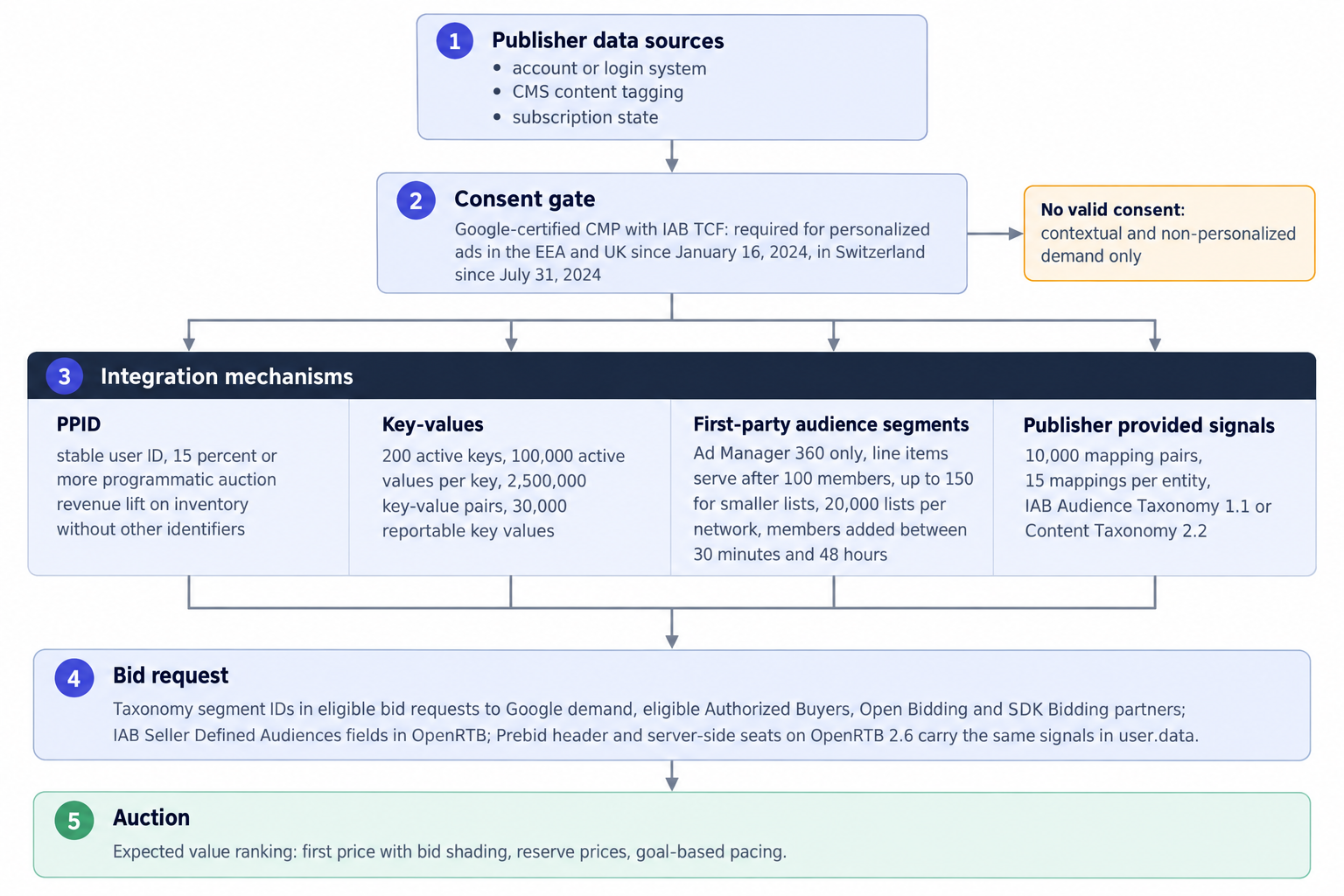
None of the mechanisms below act on traffic without a valid consent signal. Google requires a Google-certified CMP integrated with the IAB TCF for personalized ads in the EEA and UK since January 16, 2024, and in Switzerland since July 31, 2024, and only traffic from a certified CMP earns personalized ad eligibility. Everything else clears through contextual and non-personalized demand, at prices no segment can rescue.
Audit three points before writing integration code. Confirm the CMP holds current Google certification, confirm the TCF consent string reaches every request path including Prebid adapters and server-side seats, and confirm consent rate by geography lands in your reporting. A flawless segment strategy still loses to a consent gap in Germany, so fix the gate before the plumbing.
Four mechanisms, four jobs
The four integration paths stack rather than compete, and each answers a different question. Keep the questions separate in planning, because the limits attach to different objects:
- PPID: which stable user does this request belong to?
- Key-values: which attributes does this impression carry for Ad Manager targeting?
- First-party audience segments: which addressable lists does this user belong to?
- Publisher provided signals: which standardized taxonomy IDs should external bidders see?
Key-values feed segments, and both feed publisher provided signals, while PPID gives every layer a persistent subject to attach to. Skip a layer and you cap the next one: mapping publisher provided signals onto a dirty key-value space trains buyers on noise, and building segments without PPID wastes recognition on anonymous, short-lived identities.
PPID: the fastest credible revenue test
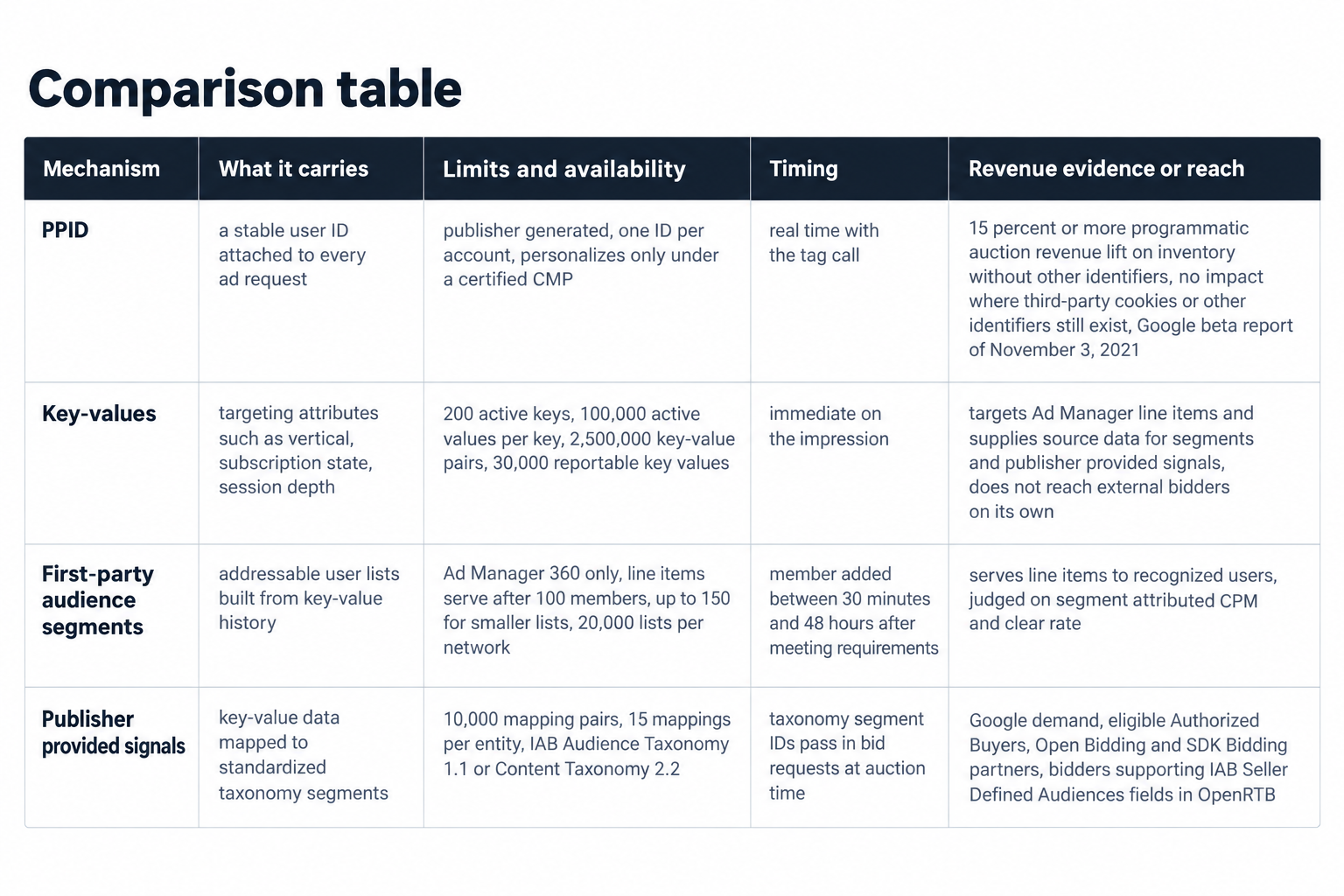
PPID is a stable string your systems generate and attach to every ad request, typically through googletag.pubads().setPublisherProvidedId() in the GPT tag. Stability is the entire value: one ID per account, constant across sessions and across devices that share a login. Generate it server side from your account system, never from an email, phone number or device identifier, and never rotate it per session, because a rotating ID reads as a new user each time and erases the recognition you built.
The November 2021 result also hands you the test design. The 15 percent benchmark applies to inventory without other identifiers, and PPIDs have no impact where third-party cookies or other identifiers still exist, so measure on Safari and Firefox traffic and on app webviews, and treat any reported lift on cookie-rich Chrome traffic as an attribution error worth investigating rather than a win worth celebrating.
Two coverage details decide the test's honesty. The ID should reach every ad call, including backfill and interstitial formats, not just the primary display slots. In the EEA, UK and Switzerland it personalizes only under the certified CMP rules above, so consent rate sets the measurable ceiling.
Key-values: the raw material and its ceilings
Key-value targeting carries what your CMS and account system already produce: content vertical, subscription state, session depth, recency buckets. Google enforces hard ceilings: 200 active keys, 100,000 active values per key, 2,500,000 active key-value pairs across the network, and 30,000 reportable key values. Ad operations teams hit the reportable ceiling first, because every value you want to optimize against has to sit inside it.
Design the taxonomy before you tag anything. A controlled set of enumerated keys, such as vertical=finance or plan=subscriber, outlives a dump of raw CMS tags, which burns the pair quota and leaves reporting unusable. Note the boundary of the mechanism: key-values target Ad Manager line items and supply source data for segments and publisher provided signals, but they do not reach external bidders on their own. Clean capture at this layer makes both downstream layers possible.
First-party audience segments: the 360 gate and the thresholds
Google restricts first-party audience segment creation to Ad Manager 360, so the feature does not exist in a standard edition account. The practical route for a publisher without a 360 contract runs through an MCM parent that operates 360, which is how we run AdX for partners who do not own a license of their own. The MCM relationship puts the parent's reporting and auction configuration in the loop, so segment strategy and settlement strategy belong in one conversation.
The thresholds shape segment design more than any targeting idea. Line items serve to a targeted segment only after it reaches 100 members, and on smaller lists the threshold can run as high as 150 users. A network can hold 20,000 audience lists. Ad Manager adds a visitor to a segment between 30 minutes and 48 hours after the visitor meets the membership requirements.
Three operational consequences follow. Size every segment to clear 150 members within the first hours of traffic, because a below-threshold list earns nothing no matter how valuable its members are. Treat day one reporting as directional and judge segments from day four onward, since the 48-hour tail keeps filling lists while you read them. Spend the 20,000 list budget on durable audience definitions, and retire dead lists instead of parking them.
Publisher provided signals: the bridge to the open market
Publisher provided signals close the gap between your private labels and buyers who will never see your CMS. Per the publisher provided signals documentation, the mechanism maps first-party data to standardized taxonomy segments, and Google standardizes the signals to IAB Audience Taxonomy 1.1 or Content Taxonomy 2.2. Ad Manager then passes the taxonomy segment IDs in eligible bid requests to Google demand and to eligible Authorized Buyers, Open Bidding and SDK Bidding partners, and bidders that support the IAB Seller Defined Audiences fields in OpenRTB can ingest them. Your data stops being private plumbing and becomes an object the buy side can price without custom integration.
The scale limits punish sloppiness: 10,000 total mapping pairs, and up to 15 mappings per entity. Map with precision. Use Content Taxonomy 2.2 for page-level context such as article verticals, and Audience Taxonomy 1.1 for user-level affinities. Never map an ambiguous value to a broad segment, because broad segments price like context rather than data, and a mislabeled mapping burns a slot and buyer trust at the same time.
Prebid, OpenRTB 2.6 and the buy side
AdX is one demand lane among several. We also integrate OpenRTB 2.6 seats and Prebid for header and server-side demand, and the same signals can travel those lanes: Prebid accepts first-party segments in bid parameters, and OpenRTB 2.6 carries audience data in the user.data object under the IAB Seller Defined Audiences structure. Keep the lanes symmetric. If the AdX request carries taxonomy segment IDs while the header request carries nothing, you have split the market's view of one impression, and header demand underbids on exactly the users AdX now recognizes.
The agency side of our company buys against the same objects we help publishers declare, over verified audiences and curated supply paths on OpenRTB 2.6 seats. The buyer's arithmetic is simple: a declared, consented segment needs no probabilistic inference, so buyers on platforms such as The Trade Desk and DV360 plan budget against it with less waste and bid with a tighter spread around true value. Publishers who declare well also negotiate better floors with those same buyers, because the buyer's risk premium shrinks.
Measurement: split by identifier presence
Measure each mechanism where Google documented its effect. For PPID, the 15 percent benchmark covers inventory without other identifiers, so split reporting by browser family and by app webview versus mobile web. For segments and publisher provided signals, judge segment-attributed economics: CPM on impressions carrying a taxonomy segment ID against the site baseline, clear rate on the same split, and revenue per thousand sessions by segment membership.
Reporting speed decides whether a test compounds. Partners verify these tests in our ten minute reporting console, because a broken mapping surfaces within hours and a winning segment deserves reinvestment before the month closes. Slow reporting does not only delay insight: every day a bad signal runs, buyers train against bad data.
The order of operations
The sequence matters because each layer feeds the next. A twelve-week cadence keeps the dependencies in order:
- Weeks 1 to 2: consent audit, CMP certification check, consent string coverage across every request path.
- Weeks 3 to 4: PPID generation and rollout, measured on traffic without other identifiers.
- Weeks 5 to 8: key-value taxonomy redesign and capture cleanup.
- Weeks 9 to 12: segment buildout against the 100 and 150 member thresholds, publisher provided signals mapping, then symmetric rollout into Prebid and server-side lanes.
Publishers who invert the order, mapping signals before cleaning key-values, spend their 10,000 mapping pairs on noise. Publishers who follow it reach the measurement phase with data both sides trust.
Failure modes worth auditing
Six errors account for most of the first-party data underperformance we review. All six are auditable in an afternoon against the numbers in this article:
- PII in the ID space: PPID or key-values derived from email or device identifiers violate policy. Generate IDs server side from the account system.
- Below-threshold segments: a list under 100 members, or under 150 on the small-list path, never serves a line item.
- Premature reads: membership takes 30 minutes to 48 hours, so day one numbers understate every segment.
- Quota burn: raw CMS tags consume the 2,500,000 pair ceiling and bury the 30,000 reportable values optimization needs.
- Asymmetric lanes: AdX carries the segment IDs while Prebid and server-side seats do not, so the market prices one impression two ways.
- Consent gaps: an app SDK path or a server-side seat that drops the TCF string sends eligible traffic into non-personalized clearing.
Run the audit quarterly and after every taxonomy change. A mislabeled mapping that slips through costs weeks of buyer trust, not an afternoon of checking.
Settlement should be the boring part
First-party data work pays out over quarters, and it deserves predictable terms. OnlyMedia pays publishers Net 30, CPM based: no chasing, no sliding terms. Every partner in our curated programmatic demand network sits above one million monthly pageviews, runs the Ad Manager, AdX and MCM stack described here, and reads the same segment economics in the same console. The sequence, consent gate, PPID, clean key-values, segments, publisher provided signals, symmetric lanes, repeats cleanly. Publishers who run it in that order collect the 15 percent class of lift on traffic that has already lost its identifiers, and they collect it while the rest of the market keeps planning.