Outstream vs. Instream Video Ads: Which Format Yields Better ROI?
Outstream video impressions typically fetch 15 to 20 percent lower CPMs than instream impressions, per a 2022 Digiday briefing that cited a media agency's programmatic director. That discount answers the wrong question. A publisher above one million monthly pageviews does not choose between two CPM lines; it chooses between two inventory strategies with different volumes, different policy exposure and different engineering costs. ROI here means marginal revenue per thousand sessions after compliance risk, and the format that wins changes with your content mix, not with the market's headline rates.
Three categories, not two
Most publishers still describe two video formats. The IAB Tech Lab amended its video guidelines in August 2022, and the amended taxonomy contains three categories. The third one, accompanying content, decides the policy treatment of most editorial video, and misreading it caused the revenue drops documented below.
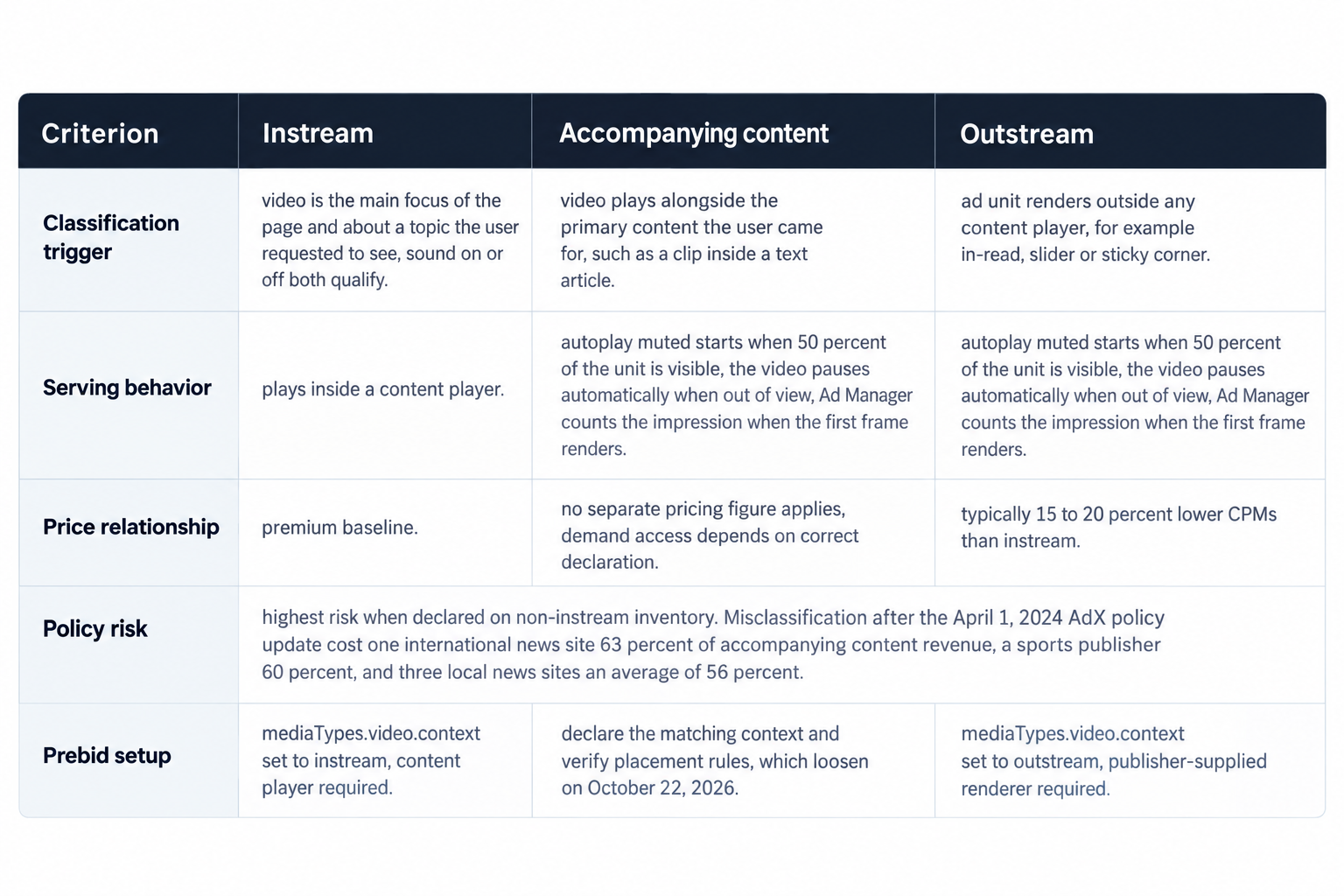
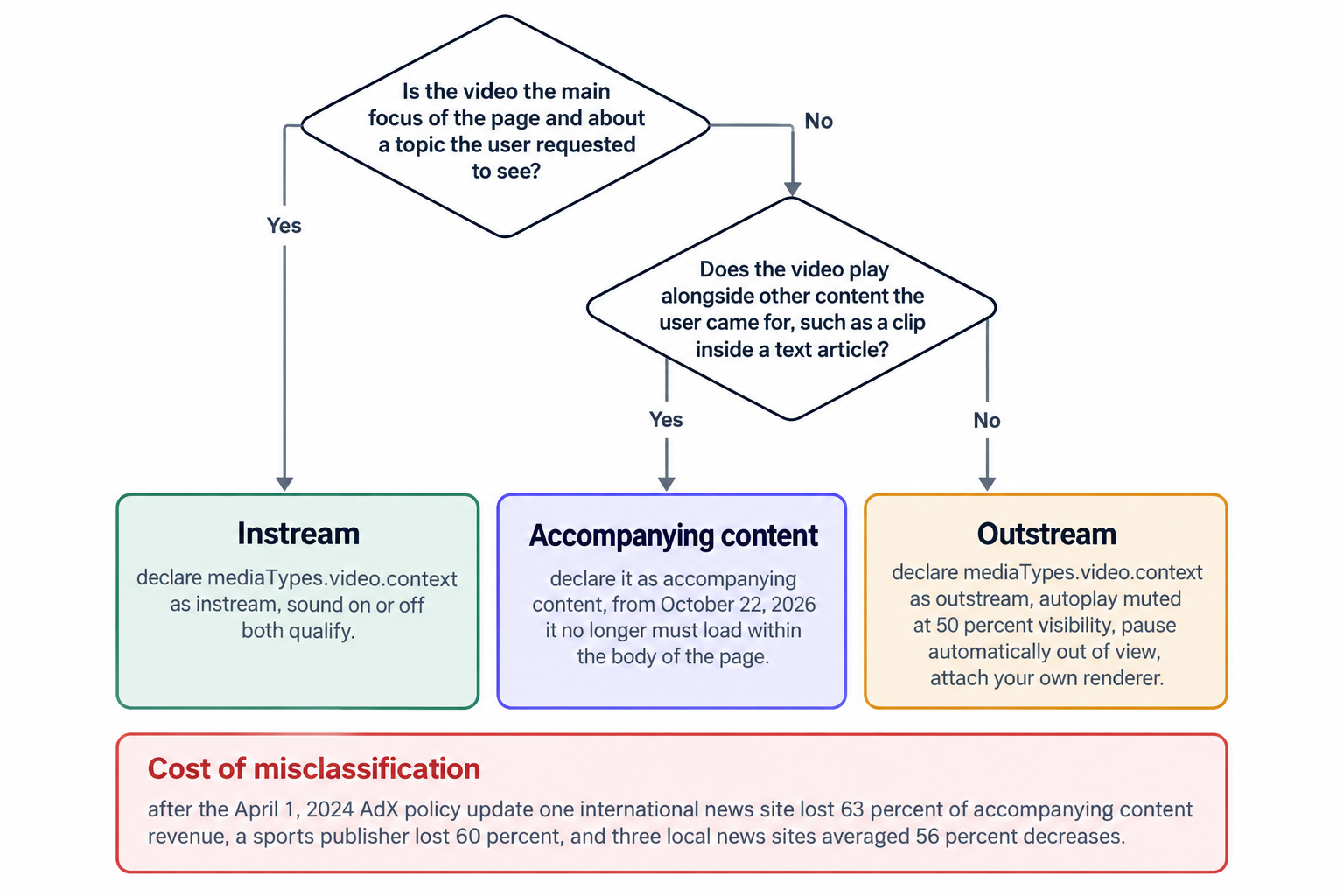
The amended IAB Tech Lab guidelines draw the lines this way. If the video is the main focus of the page and about a topic the user requested to see, it counts as instream regardless of sound on or off. The sound clause matters: an instream player that starts muted keeps its classification, which removes any reason to force sound on for classification's sake. A third category, accompanying content, sits between instream and outstream: video that plays alongside the primary material the user came for, such as a clip inside a news article. Everything else, in-read units, sliders, sticky corners and other units that render outside a content player, falls under outstream.
The taxonomy matters because OpenRTB carries the declared context in every bid request. Set the context correctly and the demand pool, the brand-suitability tiers and the clearing prices all follow. Set it incorrectly and either partners filter the request or the policy engine restricts the inventory later, at a cost the next sections quantify.
Operationalize the test at the template layer, not the campaign layer. A CMS field that records the page's primary content type, video, text or gallery, feeds the ad request, and the wrapper reads that field to set context. Manual context settings drift as templates multiply; template-driven context does not.
Why instream earns the premium
Instream earns higher CPMs for mechanical reasons. A pre-roll against content the viewer chose reaches someone who has already declared intent: they clicked for this recap, this episode, this tutorial. Completion runs high because the ad sits between the viewer and the content they want, and buyers on platforms such as The Trade Desk and DV360 concentrate video budgets where their attention metrics perform best: instream and CTV environments.
Serving that demand is a delivery problem before it becomes a sales problem. We run video at OnlyMedia across VAST 2.6 to 4.3, client-side or stitched server side (SSAI), through XML or JS tags, and the VAST version changes what a tag can carry: pod orchestration, ad signaling and stitching features vary across versions, and buyers targeting CTV-style pods expect the newer ones. Our video advertising stack covers in-stream and out-stream delivery, pod orchestration and CTV for exactly that reason.
Long-form video adds a second layer: pods. A sequence of pre-roll, mid-roll and post-roll against one piece of content multiplies impressions per session without multiplying pages, and pod orchestration controls the order buyers see. SSAI moves the decision off the client and removes the player as a single point of failure, which matters on unreliable mobile connections.
Instream carries one hard constraint: it needs video content. No player, no instream. A thin video library caps the format's share of revenue regardless of CPM, and that cap, not the premium, is what pushes editorial sites toward the other two categories.
Where outstream ROI actually comes from
Outstream monetizes pages that have no video content. An in-read unit inside a long article converts a display slot into a video slot without a content library, a production budget or a player. That is the whole thesis: a discounted rate applied to inventory instream cannot touch.
The format's economics follow from its serving rules. Ad Manager's out-of-player video requirements specify the behavior: when 50 percent of the ad unit is visible, the video plays automatically, muted; when the unit leaves the viewport, the video pauses automatically; Ad Manager counts the impression when the player renders the first frame. Read the three rules together and the CPM discount explains itself. The impression fires on render rather than on a completed view, and muted autoplay produces attention patterns buyers price accordingly.
Placement quality decides whether the discounted CPM survives contact with the buyer. The first frame renders only after the unit reaches 50 percent visibility, so an outstream slot buried deep in the page earns nothing no matter what it won at auction. Give outstream units the scroll-depth attention you would give a leaderboard, cap video units per page, and keep each unit inside the natural reading path.
The comparison that matters is not outstream CPM against instream CPM. It is outstream revenue against the display banner the slot would otherwise serve. If the video unit outearns that banner, the placement yields positive marginal ROI even at the discounted rate. The format earns its keep on coverage: it adds a video impression to pages where no instream slot can exist.
Outstream fails in predictable ways, and each failure mode is a line item. Units that autoplay with sound attract policy enforcement. Units that never reach 50 percent visibility never render the first frame, so they never count an impression. Winning bids that arrive without a renderer never display at all. Fix those three before you price the format, not after.
The classification trap that costs more than the CPM gap
On April 1, 2024, Google updated AdX's video policy to reflect the new industry definitions. AdExchanger documented the fallout among publishers that had classified accompanying content as instream: one international news site saw accompanying content revenue drop 63 percent, a sports publisher dropped 60 percent, and three local news sites averaged 56 percent decreases.
The mechanism behind those numbers is a declaration mismatch. Publishers had long treated any video inside the body of an article as instream. Under the amended taxonomy, a clip inside a text article the user came to read is accompanying content. When AdX aligned its policy, inventory that behaved like accompanying content but declared itself instream lost access to the demand tiers that pay instream rates. Nothing about the traffic changed; the revenue left anyway.
We operate as an ad network, an SSP and an agency in one company, and the audit looks different from each seat: the network sees the revenue line, the SSP sees the filtered bid stream, the agency sees the buyer's brand-suitability constraints. All three seats punish the same mistake.
So audit before you scale, not after. Pull every video placement, write down what the user came to the page for, then check the declared context in the bid request against the three-category test above. On a site above one million monthly pageviews, one misclassified template multiplied across thousands of articles produces exactly the class of revenue drop AdExchanger reported: 63, 60 and 56 percent, with the inventory itself unchanged.
What changes on October 22, 2026
Google's next policy shift carries a fixed date. On October 22, 2026, Google updates the Video Inventory Restrictions and removes two requirements: accompanying content no longer must load within the body of the page, and sticky players no longer must start in the main content. Restricted content may still receive less advertising, so the update widens what you may serve without promising that demand follows.
Treat the date as a deadline, not a gift. Three moves before it arrives:
- Test sticky and corner units against the out-of-player behavior rules now: muted autoplay at 50 percent visibility and automatic pause out of view apply to whatever you deploy.
- Declare context per placement, not per site, so a new sticky unit never inherits an instream declaration by mistake.
- Roll out new placements to one section first and measure fill, because restricted content may still see thinner demand.
The publishers who benefit from the update will have tested placements in advance, not learned about it from a revenue dip. The new rules loosen where units may sit; they do not loosen the classification rules that triggered the April 2024 losses.
Prebid setup: one field and one renderer
In Prebid, the difference between instream and outstream reduces to one field and one component. The mediaTypes.video.context value tells demand partners what environment they are buying: set it to instream for units inside a content player and outstream for units that render outside one. That single value changes the bid pool, the clearing prices and the policy treatment of the request.
The component bites harder. Not all demand partners return a renderer with their video bids, and an outstream unit has no content player to fall back on, so a winning bid can arrive with nothing to display it. The Prebid outstream guide recommends that publishers associate their own renderer with outstream ad units, and we treat that recommendation as mandatory. A renderer you control displays every winning bid consistently and gives you one place to enforce the muted autoplay, the visibility trigger and the automatic pause that the serving rules require.
The full delta between the two setups, in one place:
- mediaTypes.video.context: instream for in-player units, outstream for standalone units.
- Player: instream needs a content player with an ad slot; outstream needs your renderer.
- Renderer: attach one to every outstream ad unit regardless of what partners return.
- Protocols: declare the VAST versions your tags support, 2.6 through 4.3 in our stack, so partners do not filter the request.
- Server-side: apply SSAI where the player environment supports stitching, typically instream and CTV, not in-read outstream.
QA the two setups separately. For instream, confirm the player fires the VAST tag at the right cue and reports the quartile events partners pay against. For outstream, confirm the renderer respects the visibility trigger, the mute state and the pause behavior across browsers, because those behaviors carry the policy compliance. One test suite, two scripts, and the outstream script covers the rules the policy engine enforces.
The renderer also owns your measurement. Because the impression counts at first-frame render, log the render event, the 50 percent visibility trigger and the pause event from inside the renderer, so you show partners viewability evidence rather than assertions. We integrate OpenRTB 2.6 seats and Prebid for header and server-side demand, and both failure modes surface in the same place: partners filter requests on context mismatch, and renderers go missing at the moment of the win. Fixing the field and the renderer costs hours; leaving them wrong costs the percentages documented above.
The ROI calculation that settles the question
Compare the formats by marginal revenue per thousand sessions, not by CPM. Instream wins per impression: buyers pay the premium, sound and completion work in its favor, and one well-orchestrated pod can outearn an entire article page. But instream impressions scale with your video library, not with your traffic. Forty videos against three thousand articles caps instream revenue no matter how high the rate climbs.
Outstream wins on coverage, because it monetizes the three thousand articles. The 15 to 20 percent discount buys access to inventory instream cannot touch, and the economics turn negative only when a unit displaces a high-value display placement or trips one of the three failure modes above. That is why the honest answer to the title question splits by page type, not by format.
Measure the split with a holdback, not with a dashboard comparison. Restore the display banner to the outstream slots on one site section, keep the rest as is, and compare revenue per thousand sessions across a fixed window. The number that comes out of that test is your ROI answer, and it is specific to your layout, your audience and your demand mix. Headline CPMs never produce that number.
The auction layer decides how much of either format's theoretical value you capture. Floors set too high throttle outstream fill, and a format whose entire value is volume cannot survive a choked fill rate. Context signals that overstate the environment feed partner-side bid shading models and depress what instream clears. Read our explanation of auction mechanics and bid shading, including expected-value ranking, first-price behavior and reserve prices, before you set floors for either format.
The slot-level decision also needs the full format menu. Video competes with interstitials and high-impact display units for the same slots, and the right answer for a given placement is sometimes not video at all. Our ad format catalog lists every IAB display size plus in-stream, out-stream, interstitial and CTV video formats, and the catalog is the correct scope for this decision, because ROI belongs to the slot, not to the format.
Payment terms belong in the same model. At OnlyMedia we pay Net 30, CPM based, no chasing, no sliding terms, and we work with thousands of publishers, each above one million monthly pageviews. Predictable payout sits next to CPM whenever you evaluate a demand partner, because revenue that arrives late distorts every ROI projection you build. Our curated programmatic demand network serves publishers at that scale.
The verdict, format by format
Instream yields better ROI per impression, per session and per unit of policy risk wherever genuine video content exists. Intent, sound, completion and pod orchestration all pay, and the demand behind them prices at a premium outstream never reaches.
Outstream yields better marginal ROI on pages instream cannot monetize at all, provided the unit meets the out-of-player behavior rules, carries a renderer you control and declares its context honestly. The 15 to 20 percent discount is the price of coverage, and coverage earns its keep on text-heavy sites.
Accompanying content decides how much of either number you keep. Declare it correctly and it earns its own demand. Declare it as instream and the April 1, 2024 precedent shows the cost: 63 percent at one international news site, 60 percent at a sports publisher, 56 percent on average across three local news sites.
Run both, on the pages that fit each, and let the audit decide the split. Classify against the IAB test, wire your renderer into every outstream unit, price with the auction mechanics in view, and re-check the whole setup before October 22, 2026. The format question resolves itself once the classification question does.