Retail Media Networks: Can Niche Content Publishers Get a Piece of the Pie?

IAB's forecast puts retail media at about 74.06 billion dollars for 2026, and most of that money will never touch a content publisher's page. Sponsored products, on-site display and in-store signage live inside retailer properties, priced against purchase history and SKU-level data that no independent site can match. The reachable slice is the off-site extension: ads built on retailer data that follow shoppers onto the open internet, connected TV, social platforms and publisher sites. That slice matters for two reasons: 2026 belongs to it, and the buyers holding these budgets are openly dissatisfied with the marketplaces that sell the rest of the channel.
For a niche publisher with two to five million monthly pageviews of recipes, DIY, parenting or car reviews, the question is not how to compete with a retailer's storefront. The question is how to become the inventory where a grocer's or a big-box retailer's purchase data lands when a campaign extends past that storefront. The buyer complaints define the opening, the new measurement standards define what you must ship, and the deal mechanics decide whether the demand clears in your favor.
Where the 74.06 billion dollars actually sits
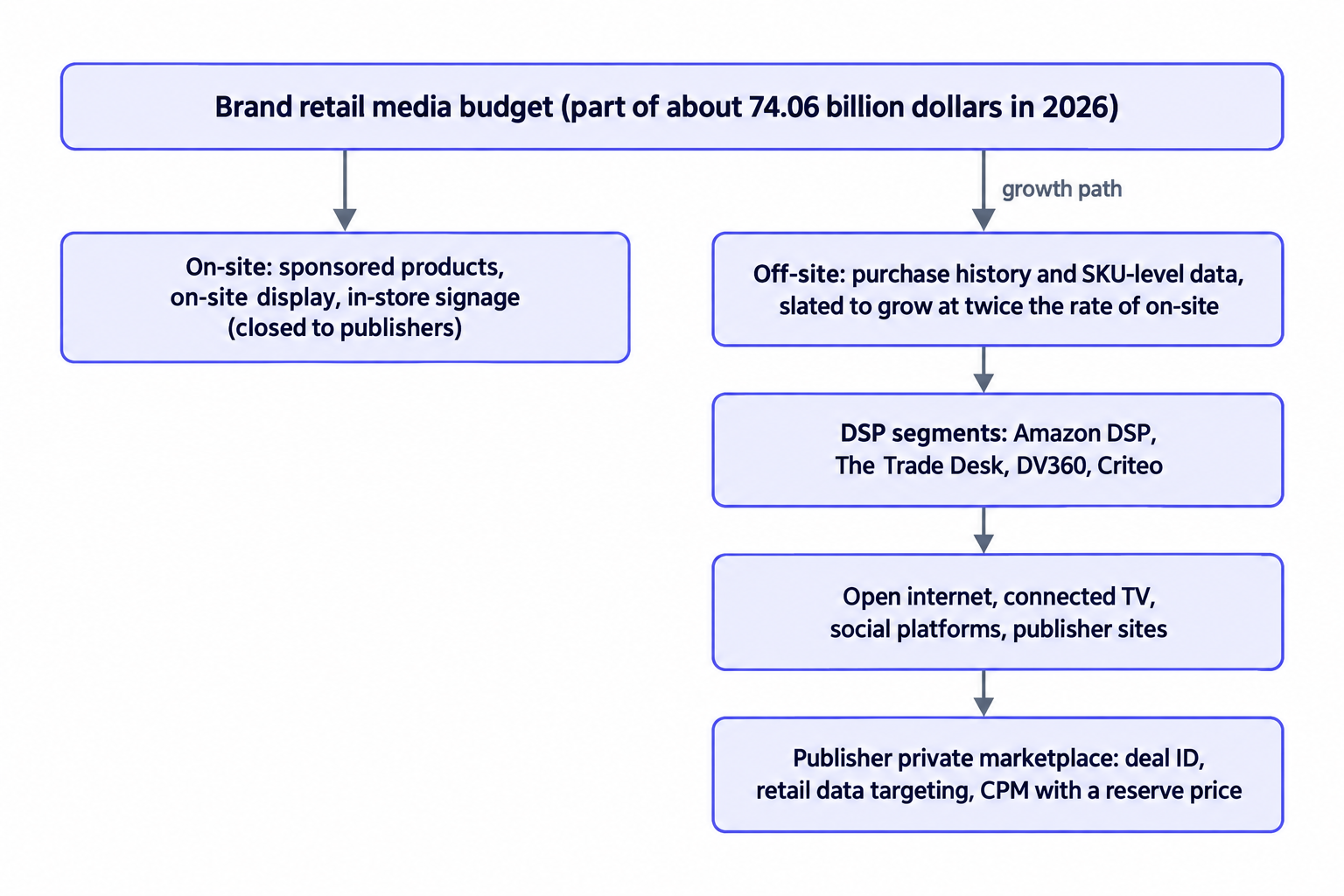
The forecast spans four channel types: sponsored products, on-site display, in-store signage and off-site ads. Targeting strength across all four comes from purchase history and SKU-level data, which is why retailers can charge premiums that context alone cannot justify. Publishers have a claim on exactly one of the four: the off-site extension, where retailer audiences leave the store and land on open web inventory.
The growth numbers keep moving up. IAB's January 2026 Outlook Study projected commerce media growth of 12.1 percent for the year. In September 2026, IAB raised the 2026 ad spend forecast for the United States to 12.3 percent growth for the full year, and the channel table revised commerce media to 13.6 percent, up from the 12.1 percent its January Outlook Study projected. A mid-year upgrade of that size signals demand running ahead of planning, and budgets that outrun their plans tend to spill past their original channels.
Retail media networks such as Amazon Ads, Walmart Connect, Kroger Precision Marketing and Instacart built their businesses on the closed portion: sponsored product placements, on-site display and, more recently, in-store screens. Off-site is the piece they syndicate, licensing purchase-based audiences into demand side platforms so buyers can extend reach beyond the retailer's walls. Your entire opportunity sits inside that syndicated piece.
Why the off-site slice grows fastest
Off-site retail media spending in 2026 is slated to grow at twice the rate of on-site, per AW360's off-site growth analysis. Retailer data targets shoppers across the open internet, connected TV, social platforms and publisher sites, which turns publisher impressions from an afterthought into a required input. Three forces drive the gap. On-site inventory saturates once a retailer has sold its search and storefront placements, so growth has to come from somewhere else. Purchase-based segments outperform demographic proxies everywhere they run, so buyers push them onto the widest canvases available. Frequency goals need more surface than a single retailer property offers, so budgets extend to connected TV, social and the open web, and every one of those extensions ends at publisher inventory.
In practice the segment types are concrete: past purchasers of a specific SKU, category buyers who have not tried the brand, lapsed buyers drifting out of the repurchase window, and brand switchers identified from rival purchase patterns. Each segment needs impression volume outside the retailer's walls, and publisher inventory supplies it at a CPM the buyer can model against basket size.
For niche content publishers the pairing is specific. A grocery purchase segment hitting a reader mid-recipe benefits twice: the segment proves the shopper buys the category, and the context proves the reader is planning the next purchase right now. That agreement between data and context is the one thing an on-site placement cannot offer, and it is what off-site retail media buys when it buys your pages.
Buyer frustration is the opening
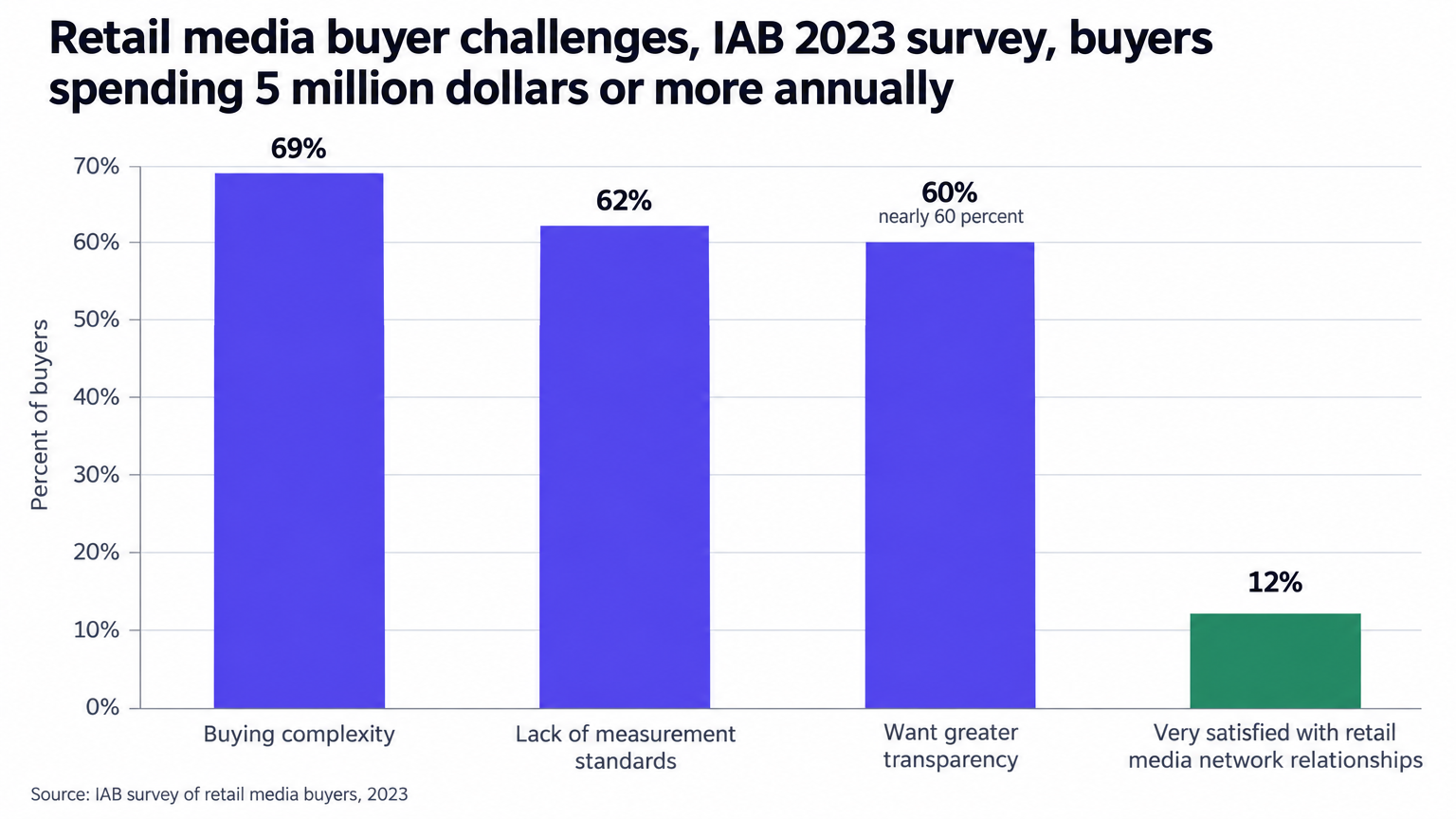
The buyers holding this budget are unhappy with the marketplace they buy it in. In IAB's 2023 survey of retail media buyers spending 5 million dollars or more annually, 62 percent cited lack of measurement standards as a top challenge, nearly 60 percent wanted greater transparency, 69 percent cited buying complexity, and only 12 percent were very satisfied with their retail media network relationships. Those numbers come from the survey IAB published alongside the IAB and MRC measurement guidelines, the first serious framework for retail media measurement.
Read those percentages as a map. Complexity taxes every dollar moved through a large marketplace, opacity hides the tax, and weak measurement makes it unaccountable. A niche publisher with a direct line to the buyer can remove all three for a defined slice of the budget: one deal ID, one disclosed path, one standard set of metrics. Small and mid-sized publishers win exactly where the marketplaces frustrate, with a named contact who can state where an impression ran and which method counted the outcome.
What the new measurement standards demand
Standards work is turning that frustration into requirements. IAB Europe's Commerce Media Measurement Standards V2 arrived in January 2026 with a grace period through end of July 2026. The document refines the measurement funnel, standardizes gross and net sales definitions, and formally defines incrementality with approved methodologies. A lack of standardisation remains the biggest barrier to retail and commerce media growth, and V2 attacks that barrier head on.
The funnel refinement matters because retail media reporting has historically compared incompatible stages: one network counted an impression as engagement, another counted a click, and neither matched the retailer's sales file. Common stage definitions let a buyer compare your inventory against a marketplace placement on equal terms, and honest comparison is where independent publishers win.
For ad operations, V2 changes what a retail media kickoff must cover. Your reporting has to state whether sales outcomes count as gross or net, because a buyer measuring gross sales against net-basis reporting will read a working campaign as a failure. Your placements need identifiers that survive the whole chain, from deal ID through placement taxonomy to the retailer's clean room join. Your viewability measurement has to follow IAB guidelines rather than ad server defaults, because the guidelines are what the buyer's verification partner checks.
Incrementality testing touches publishers most directly. Buyers run holdout tests to prove lift, which means your audience definitions and targeting keys must stay stable for the full flight. We run measurement studies through DSP seats and agency direct lines, and the studies that survive verification come from publishers who held their configuration still for six weeks.
What a niche publisher actually sells
Scale is not the product. A retail media buyer can reach three million shoppers faster through a demand side platform than through any single publisher, so a pitch built on reach loses before it starts. What a niche publisher sells is category authority at the moment of intent, plus addressable inventory that retailer data can match against.
The vertical pairings are concrete:
- Recipe, meal-planning and food content pairs with grocery and CPG budgets, the segment types Instacart and Kroger Precision Marketing syndicate.
- DIY, home improvement and gardening content pairs with hardware and home retail budgets.
- Parenting content pairs with baby, toy and back-to-school retail.
- Pet content pairs with pet food and supply retail, one of the most subscription-driven categories in commerce media.
- Car review, maintenance and ownership content pairs with auto retail and aftermarket budgets.
- Tech and appliance reviews pair with electronics retail, especially around launch and holiday windows.
In every pairing the reader is mid-task and the retailer's data confirms the reader is mid-category. That double confirmation is the pitch.
Addressability decides whether any of it works. Retailer segments match against hashed email logins, newsletter audiences and declared first-party data inside clean rooms such as Amazon Marketing Cloud, where the publisher side never sees the shopper's purchase history and the retailer side never sees the publisher's users. Your job on the sell side is to grow the matchable base: logged-in readers, a consented email newsletter, and an identity signal that travels with the impression. Consent strings, including TCF signals where they apply, must resolve correctly before the first test, because retailers will not let their data land against non-compliant inventory.
The transaction path into your ad server
Follow the dollar. A brand allocates retail media budget to a network like Walmart Connect, or to a demand side platform with retailer data licensed in. The buyer builds a segment, activates it in Amazon DSP, The Trade Desk, DV360 or Criteo, and extends the campaign to the open internet, connected TV, social and publisher sites. Your impressions appear as the only placements in the plan where purchase data and content context agree.
The path holds only when both ends of it are built. On the buy side, campaigns reach inventory through verified audiences and curated supply paths built on OpenRTB 2.6 seats. On the sell side, at OnlyMedia we integrate OpenRTB 2.6 seats and Prebid for header and server-side demand, so the activation layer and the auction layer speak the same version of the protocol. We work both ends as an ad network, an SSP and an agency in one company, and retail segments often clear through server-side pathways when buyers extend into connected TV, so a stack with header bidding alone misses part of the demand.
The sell-side checklist is short but unforgiving:
- ads.txt and sellers.json entries that match your live paths; buyers running supply verification disqualify a deal over a single mismatch.
- A SupplyChain object passed through Prebid adapters so every hop in a resold impression stays visible.
- Deal IDs exposed through header and server-side adapters, named for the retail category and segment they carry.
- Programmatic guaranteed and standard private marketplace line items in Google Ad Manager, with category and audience keys the buyer can target.
- Identity support that survives without third-party cookies: hashed email logins, consented first-party IDs, clean room match keys.
None of this is retail media specific. It is the hygiene that lets a retail media buyer treat your inventory as performance media instead of open exchange reach.
Pricing, floors and payout terms
Retail media buyers purchase outcomes, but your inventory still clears in CPM auctions, and the translation happens in the deal structure. The segment fee sits on the buyer side inside the DSP, your CPM covers the impression, and the buyer's return math blends the two. Your reserve price should therefore reflect what an impression is worth with a proven purchaser behind it, not what open exchange demand pays for the same slot.
Price with the auction's real rules in mind. First-price auctions with bid shading mean a headline bid of 12 dollars can clear at 8.50, and expected-value ranking means a retail deal that wins fewer, better impressions can outperform a louder bidder on revenue per thousand. Set reserve prices per deal, review win rate and clear rate weekly, and treat a reserve change as a two-week experiment rather than a permanent setting.
Payout terms decide whether a pilot becomes a program. OnlyMedia pays publishers Net 30, CPM based, no chasing, no sliding terms, and our curated programmatic demand network works with thousands of publishers, each above one million monthly pageviews. A retail media pilot on those terms reconciles the same month it runs, which is the difference between a test the buyer forgets and a line item that appears in the next quarter's plan.
Pitfalls that kill retail media pilots
Most retail media pilots die from a handful of avoidable errors:
- Gross and net mismatch. State the sales basis in the kickoff and repeat it in the report header. A buyer who measures gross sales against net-basis reporting cancels by week three.
- Data leakage. Never pass raw email addresses in bid requests. Matching happens inside clean rooms with hashed identifiers, and consent signals must resolve correctly before the first impression serves.
- Cannibalization. A retail segment can bid against your endemic direct advertiser on the same impression. Cap the overlap deliberately or price it as a package, otherwise you trade a guaranteed insertion order for a single auction win.
- Mid-flight audience changes. An incrementality holdout breaks the moment a targeting key changes, and a broken test reads as zero lift even when the campaign worked.
- Broken reseller paths. One stale sellers.json entry disqualifies your inventory with buyers running supply verification, and retail media buyers verify hardest because their brands demand audit trails.
Every pitfall above is operational rather than strategic. Nothing here requires new content, new formats or a rebrand; it requires an ad operations team to treat retail media buyers as a distinct buyer class with distinct requirements.
A 90-day sequence that lands in the next planning cycle
Retail media budgets move on a quarterly cycle, so run the build in three phases that fit inside one quarter.
- Days 1 to 30: audit. Pick two retail categories where your content and reader intent genuinely match, verify ads.txt and sellers.json against your live paths, and confirm your hashed email base is large enough to matter in a clean room join.
- Days 31 to 60: package. Build one private marketplace per category with deal descriptions that name the retail data segment, set initial reserve prices from your current 75th percentile clear, and open conversations with buyers running retail budgets through their agencies.
- Days 61 to 90: prove. Run one category pilot with a fixed flight, stable audience keys and a stated gross or net basis, deliver the report against the V2 measurement funnel, and use the verified lift to price the next quarter.
A publisher with a completed pilot enters the next cycle as an option rather than a pitch.
Can niche content publishers get a piece of the pie? Yes, with a precise definition of the piece. The on-site share of the 74.06 billion dollars belongs to the retailers, and the in-store signage never leaves the building. The off-site extension, the part slated to grow at twice the rate of on-site, lands on open web inventory when publishers make it landable: verified paths, matchable audiences, standards-compliant measurement and pricing set against first-price reality. The buyers funding the channel are dissatisfied with complexity, transparency and measurement, and each of those complaints is something a well-run niche publisher can answer directly. The grace period runs through end of July 2026, and while it runs, buyers are choosing which publishers to certify against the new standards. After that, the certified publishers take the budgets.