Rewarded Video Ads Beyond Gaming: New Applications for Content Sites

Google's own documentation for web rewarded ads lists content rewards first: the reward could be 3 news articles, 10 gold coins, an extra life in a game, or wifi access at an airport. The news articles sit ahead of the gold coins. Rewarded video grew up in mobile gaming, but the web implementation treats access to content as the primary use case, and almost no content publisher traffics it.
The gap has a simple cause and a real cost. Publishers file rewarded under gaming, so ad operations teams never build the slot. What they skip is the only web format where the user asks for the ad: affirmative opt-in, a stated reward, and a 5 second in-view rule before the grant. No pre-roll or out-stream placement carries that attention profile.
For sites above one million monthly pageviews, the format attaches to surfaces you already operate: metered paywalls, tool gates, download buttons, interstitial frequency caps. None of those surfaces needs a product redesign, only a slot, a disclosure, and a reward your code can deliver.
How a rewarded impression works on the web
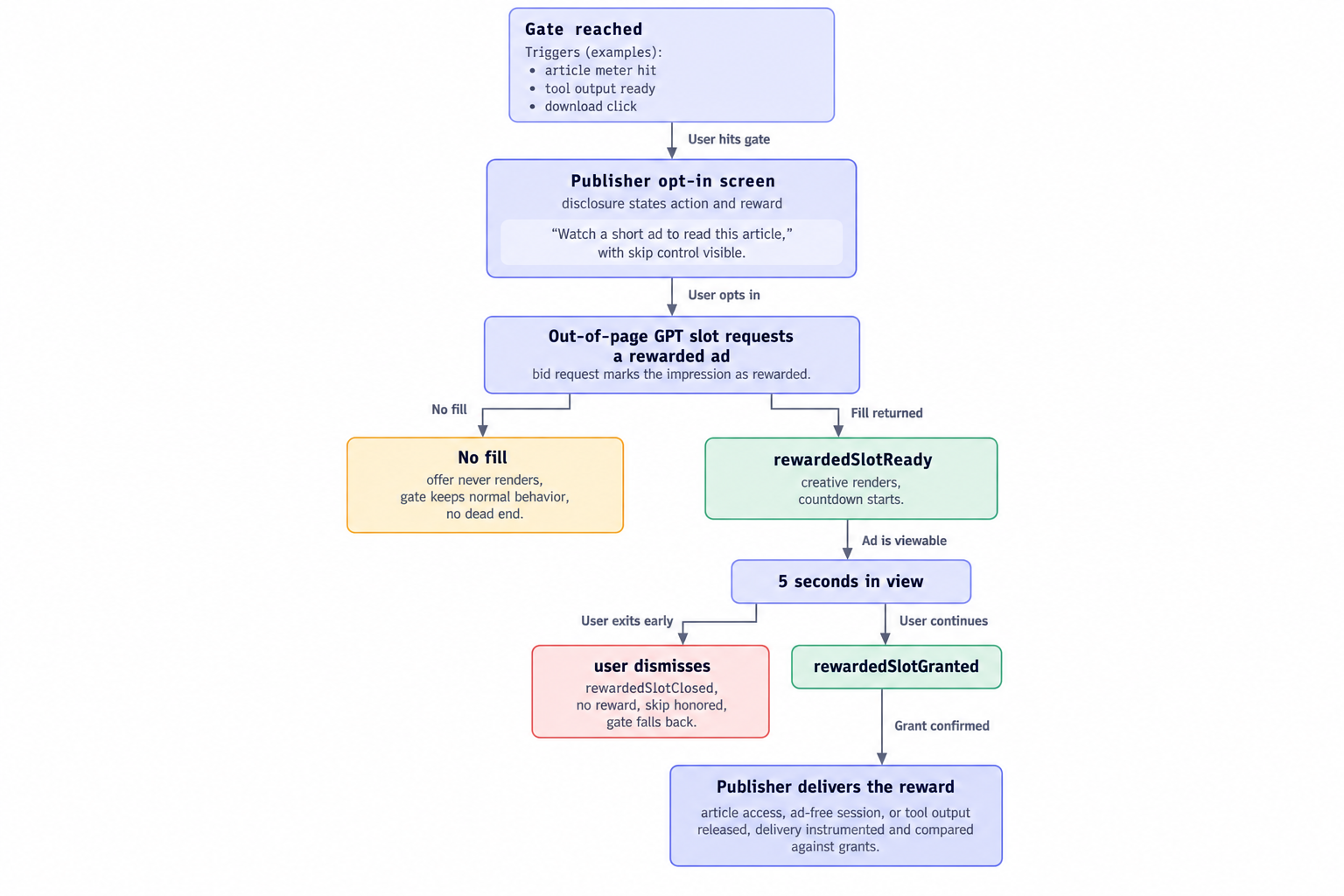
A rewarded ad is a trade the publisher states out loud: watch this short ad, receive this reward. The experience lets a user voluntarily opt in to an ad experience in exchange for a reward, which is the cleanest consent signal available on the open web. Google supports trafficking rewarded ads on web across desktop, mobile, and tablet inventory in Ad Manager, so the format is a first-class web citizen rather than an app export.
On web, the publisher carries responsibilities an app SDK absorbs in games. You create and display the opt-in screen. You deliver the reward. And you honor the timing rule: the ad must be in view for 5 seconds for a reward to be granted.
The GPT implementation uses out-of-page slots and three events. rewardedSlotReady fires when a rewarded ad returns for the slot and your player can render it. rewardedSlotGranted fires when the ad has stayed in view for 5 seconds, the moment the user earns the reward. rewardedSlotClosed fires when the player closes, granted or not. Google documents this event path on mobile-optimized pages, which is where content consumption concentrates anyway.
Two properties distinguish the web implementation from its app ancestor. First, the opt-in screen is yours, so its copy, placement and styling follow your brand, not a network template. Second, the reward delivery is yours, which means the reward can be anything your code can release: an article, a session flag, a file, a calculation. Key the reward to rewardedSlotGranted, never to a countdown you write yourself. The event fires only on verified in-view time, so you release the reward exactly when the user has earned it, and your grant reporting stays honest.
The policy perimeter
Google's policies for rewarded ad units draw four hard lines, and every one of them lands in your implementation:
- Opt-in must be affirmative and unambiguous. The ad serves only after the user actively accepts the offer. A pre-checked box, a vague Continue button, or an auto-starting player all fail the test.
- Skip and dismiss must stay available. The user can always walk away without the reward.
- Disclosure precedes each instance. State the action required and the reward offered every single time, not once in a footer or a terms page.
- Direct monetary items may not be offered as rewards under any circumstance. No cash, no wallet credit, no gift balance.
What remains is wide open: content access, ad-free time, feature use, tool output, a printable document. Most of those rewards cost nothing at the margin on a content site, which is exactly why the format fits publishing economics better than its gaming reputation suggests.
One boundary deserves its own sentence. The reward buys watch time, never a click on the ad. Tying rewards to ad engagement invites invalid activity and burns buyer trust, and the grant event already gives you the honest metric.
Five placements that work on content sites
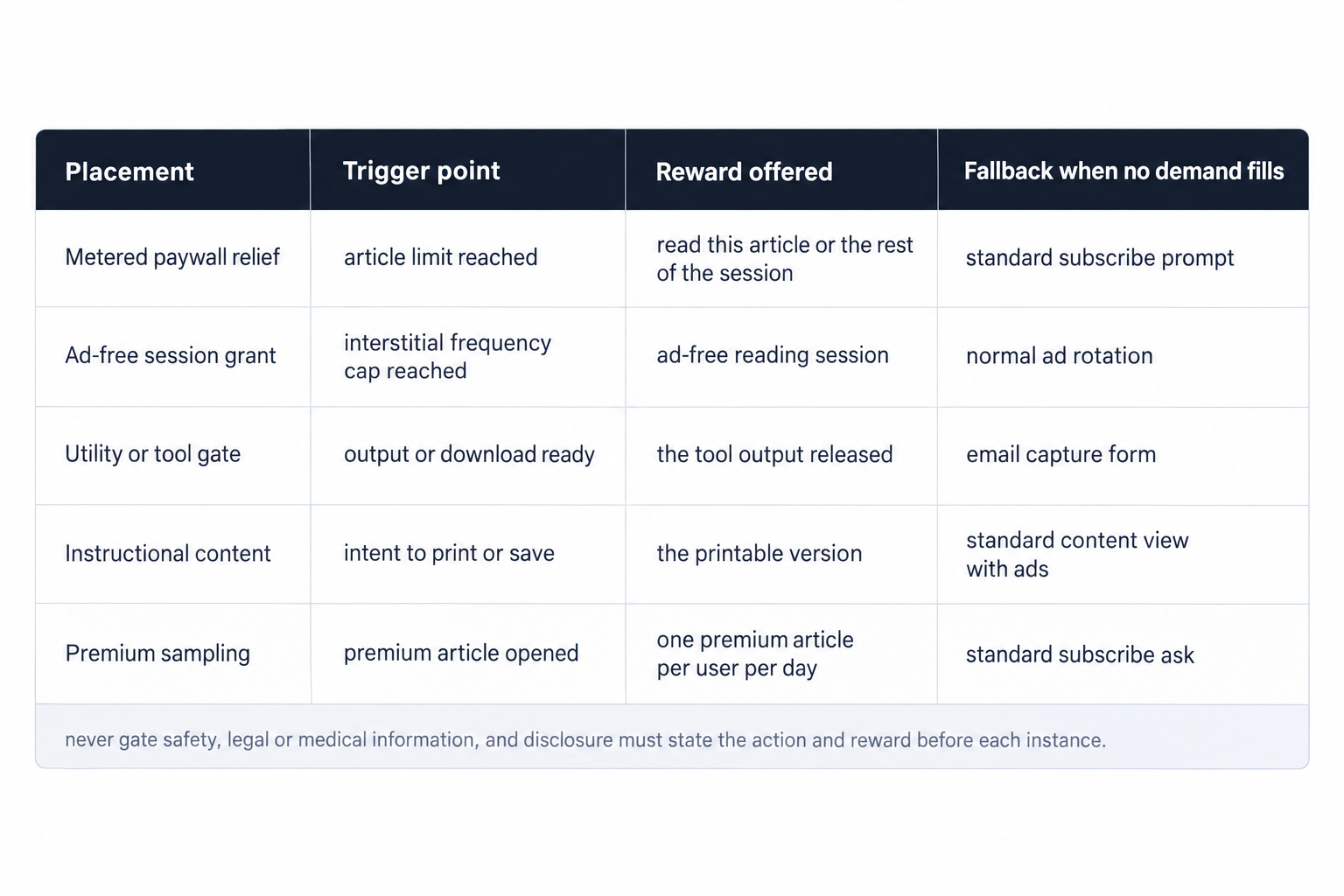
Any content model qualifies. The real question is where a gate already exists: rewarded slots attach to the moments where you currently ask for money, an email address, or patience.
- Metered paywall relief. The user hits the article limit. Offer the trade: watch a short ad, read this article or the rest of the session. The meter still counts for subscribers; the rewarded path catches readers who will never pay but will watch. On a no-fill, the meter falls back to its normal subscribe prompt.
- Ad-free session grants. Pair the slot with your interstitial frequency cap: once the cap trips, offer one rewarded ad in exchange for an ad-free reading session. You convert an interruption moment into a consent moment. On a no-fill, the session continues under normal ad rotation.
- Utility and tool gates. Calculators, converters, generators, template and file downloads. The trigger is the moment the output is ready; the reward is the output itself. Keep the email form as the fallback for users who decline.
- Instructional content. Recipe cards, printable plans, wiring diagrams, workout sheets. Offer the ad at the point of intent to print or save, when the value of the document peaks, and release the printable as the reward. On a no-fill, the document opens under your standard setup.
- Premium sampling. One premium article per user per day in exchange for a watch, a tasting menu for the subscription you still want them to buy. On a no-fill, the prompt reverts to the standard subscribe ask.
Two limits apply everywhere. Never gate emergency, safety, legal, or medical information behind any ad. And write disclosure a policy reviewer would pass on sight: Watch a short ad to read this article, with the skip control visible in the same frame.
The paywall alternative Google already ships
Google ships a content path for exactly this pattern. Creating a rewarded ad call-to-action in Reader Revenue Manager lets site visitors watch a short ad to earn access to site content, and it functions as a paywall alternative. The detail that matters most to ad operations sits in the failure case: if no rewarded ad is available due to insufficient demand, the message doesn't show.
That is the correct design, and it should govern your own implementation. The offer is demand-aware, and your gate degrades to its normal behavior when the auction returns nothing, so no user ever hits a promise you cannot fill. Build the null path before the happy path, and test what a user sees when demand returns mid-session.
The path coexists with a subscription business rather than replacing it. The rewarded call-to-action catches the reader who will not pay today, and your subscribe prompt still catches the reader who will. Track how many readers graduate from rewarded access to paid access, and treat that graduation rate as a health metric for the whole arrangement.
Trafficking, Prebid, and where the demand sits
In Ad Manager the setup is small. Create an out-of-page ad unit on the template, enable rewarded on the line items or programmatic demand you point at it, add key-values to separate templates, and traffic video creative sized for your player. Desktop, mobile, and tablet web inventory all qualify, so launch on mobile-optimized pages first and widen from there.
The bid request should carry the context. We integrate OpenRTB 2.6 seats and Prebid for header and server-side demand at OnlyMedia, and we mark the impression as rewarded in the bid request so buyers know they bid on a consented, opt-in placement with a completion dynamic. A trading desk running in-app rewarded lines on The Trade Desk or DV360 reads that signal and can extend the campaign to web inventory where the same consent holds.
Why the budget exists at all: Google internal research reported 50 percent of users would be less satisfied with their app experience if rewarded ads were removed. Treat that as app-experience research, not web data, and keep it out of web performance decks. It explains the demand, though. Users describe the rewarded exchange as part of the product rather than as interruption, and buyers pay for that posture.
Be honest about depth. Rewarded demand on web runs thinner than display, which is why the Reader Revenue Manager path hides the call-to-action when nothing fills. And no primary source we would put in front of a client exists for web rewarded eCPMs, so treat any range a vendor quotes as folklore. Set floors per placement rather than per format, because a rewarded slot on a tool gate and a rewarded slot on a metered article serve different intent, and buyers price intent. Run your own floor test for two weeks and read your own numbers.
We work with thousands of publishers, each above one million monthly pageviews; our curated programmatic demand network puts a rewarded test in the same auctions as your display and video stack. Rewarded slots join that stack rather than replace it: the same pages keep every IAB display size plus in-stream, out-stream, interstitial and CTV video formats.
Measurement: the rewarded funnel
Rewarded gives you an event chain display never had. Measure the chain end to end:
- CTA renders: how often the offer appears at the gate.
- Opt-in rate: users who accept the trade.
- Ready rate: rewardedSlotReady per CTA render, which exposes demand depth on your inventory.
- Grant rate: rewardedSlotGranted per ready event. The 5 second in-view rule makes this a real attention metric, a user who stayed and watched.
- Close rate: rewardedSlotClosed before grant, the users who walked away.
- Delivery rate: grants where your code actually released the reward. The event fires client side, so instrument it and alert on any gap between grants and deliveries.
Directionally, ready rate diagnoses demand, opt-in rate diagnoses copy, and grant rate diagnoses creative. A ready rate stalled near zero means no buyer sees value at your floor, so fix the floor or the bid request signal before touching UX. A weak opt-in rate usually means the disclosure hides the reward or the trigger mistimes the offer, so fix the copy or the gate before blaming demand.
Run a 50/50 holdout on gated sessions for two weeks. Compare pages per session, return visits, and subscription conversion between arms, then compare total session revenue with the rewarded line included and the displaced formats counted honestly. Start with one rewarded offer per session, tighten on close-rate data, loosen on grant-rate data.
Expect the center of gravity on mobile, since Google documents the GPT event path on mobile-optimized pages. Split every metric by device with device-level reporting, and keep rewarded lines beside display and video in the ten minute reporting console so nobody reads the format in isolation. At OnlyMedia we pay publishers Net 30, CPM based, no chasing and no sliding terms, so a two week test settles in the next payment cycle instead of a quarter out.
A staged rollout
Sequence the work so policy and product questions surface before spend questions do:
- Audit your gates. List every point where you ask for money, an email, or patience, and mark the rewards that cost nothing at the margin.
- Build the slot and the events. Out-of-page unit, the three GPT events, reward delivery keyed to rewardedSlotGranted, and the null path for unfilled auctions.
- QA the disclosure. The action and the reward stated before each instance, the skip control visible, and no monetary reward anywhere in the copy.
- Soft launch one template, mobile first, on a 50/50 holdout of gated sessions. Watch ready rate and grant rate daily.
- Cap frequency. One offer per session to start, with interstitial caps retuned so the two formats never stack in a single navigation.
- Widen. Go to desktop and tablet, then to a second template, only after delivery rate holds close to grant rate.
Failure modes that actually happen
Most rewarded problems trace back to six mistakes:
- Stacking: an interstitial and a rewarded offer in the same navigation turn an opt-in format into an interruption pile.
- Timer cheating: granting the reward on your own countdown instead of rewardedSlotGranted breaks the attention contract and corrupts your reporting.
- Dead ends: a call-to-action that renders when demand is gone. The Reader Revenue Manager path avoids exactly this by not showing the message.
- Rewarding clicks: never tie the reward to clicking or engaging with the ad. The exchange is watch time, and the grant event already measures it.
- Gating essentials: safety, legal, and medical pages carry no gates of any kind.
- Vague copy: Watch a short ad to read this article beats Continue, and the policy requires the specific version.
Agencies advising content publishers should audit the gates before the ad server: the value sits in the product decision about which moments deserve a reward path. Publishers should pick rewards with zero marginal cost and wire delivery to the granted event, not to optimism. Google wrote 3 news articles into its own example list ahead of the gold coins. The remaining work is execution: state the trade, honor the 5 seconds, deliver the reward, and report the grant.