The Future of Native Advertising in a Fully Automated Programmatic World
A specification that has not changed since July 2017 still describes every automated native impression a publisher sells today. OpenRTB Dynamic Native Ads 1.2, dated March 2017 and updated that July, defines the machine contract for native: what the request declares, what the bid returns, and which tracking the buyer commits to. Full automation of native therefore does not wait on a new standard. It waits on publishers and ad operations teams executing the existing one precisely, at scale, against rendering code they control.
The machine contract: imp.native in, adm out
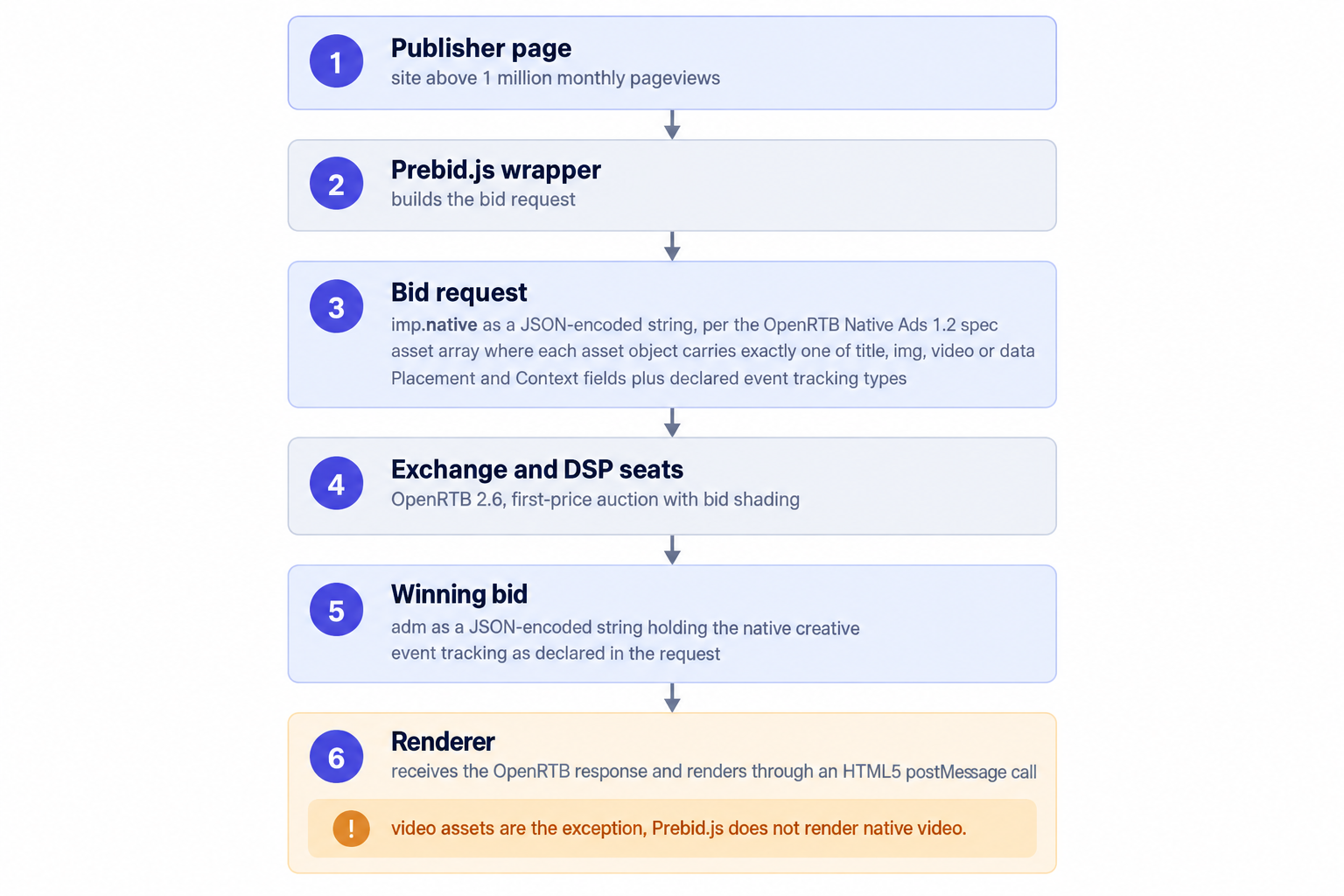
The bid request carries the native object as a JSON-encoded string inside the imp.native field, and that object defines the advertising opportunity: which assets the placement accepts, the limits on each asset, and the data fields, such as sponsor or description, the unit supports. The winning bidder returns the creative as a JSON-encoded string in the adm field of the bid. In the default flow the asset array is the creative, and nothing else travels between systems.
The OpenRTB Native Ads specification 1.2 requests assets as an array, and each asset object carries exactly one of title, img, video, or data. That constraint does more than keep the schema tidy. It forces every native unit to decompose into typed components, which is precisely what an automated buyer needs to assemble a creative without a trafficking step. A buyer cannot template against a vague block of markup; it can template against a title with a declared maximum length, an image with a declared aspect, and a data field with a declared type.
Version 1.2 made three changes that matter more each year. It added support for third-party ad serving and for dynamic creative through URL responses, which lets a buyer assemble the ad at fetch time instead of pushing static markup. It moved event tracking types into the bid request, so the parties agree on measurement before the auction rather than after the impression. And it deprecated the AdUnit and LayoutID fields in favor of Placement and Context, two signals that tell a buyer where the unit sits and what surrounds it.
Treat imp.native as a creative template renegotiated on every request. When your declared constraints match what your renderer enforces, every bidder can pre-build templates against your placement. When they drift, buyers shade bids for the uncertainty or drop the placement from their native lists, and both outcomes look identical in your reporting: soft CPMs with no error anywhere.
Prebid.js runs the auction, you run the last mile
Prebid.js implements native per the OpenRTB 1.2 spec, with one notable exception: it does not render native video. The wrapper passes the OpenRTB response to your rendering code, and the unit renders through an HTML5 postMessage call. The Prebid.js native implementation guide documents this flow, and the flow has a blunt operational meaning: the auction, the exchange and the payload are automated, while the last mile, the part the reader actually sees, runs on code you own.
The consequences pile up quickly. Your CSS controls layout, so text truncation, image overflow and broken aspect ratios are your defects, not the buyer's. Your renderer must validate the adm string before it writes to the page, because a malformed payload that reaches the DOM produces a broken unit that still counts as a served impression. And because Prebid.js does not render native video, a request that includes a video asset hands the entire rendering burden to you: either build and test a video renderer, or stop requesting video assets in programmatic native placements.
Monitoring closes the loop. Track three figures per placement: bid rate, render success rate, and time from response to paint. Bid rate tells you how the request reads on the buy side. Render success tells you how your renderer handles real adm payloads. Paint latency tells you whether the postMessage handshake costs you viewability. A placement with strong bids and weak renders loses money in a way no auction report will ever show, because the impression still counts.
None of this argues against Prebid for native. It argues for treating the renderer as production code, with an owner, a changelog and a test matrix, because in a fully automated stack the renderer is the only component where a human can still break the ad.
Ad Manager draws a hard line
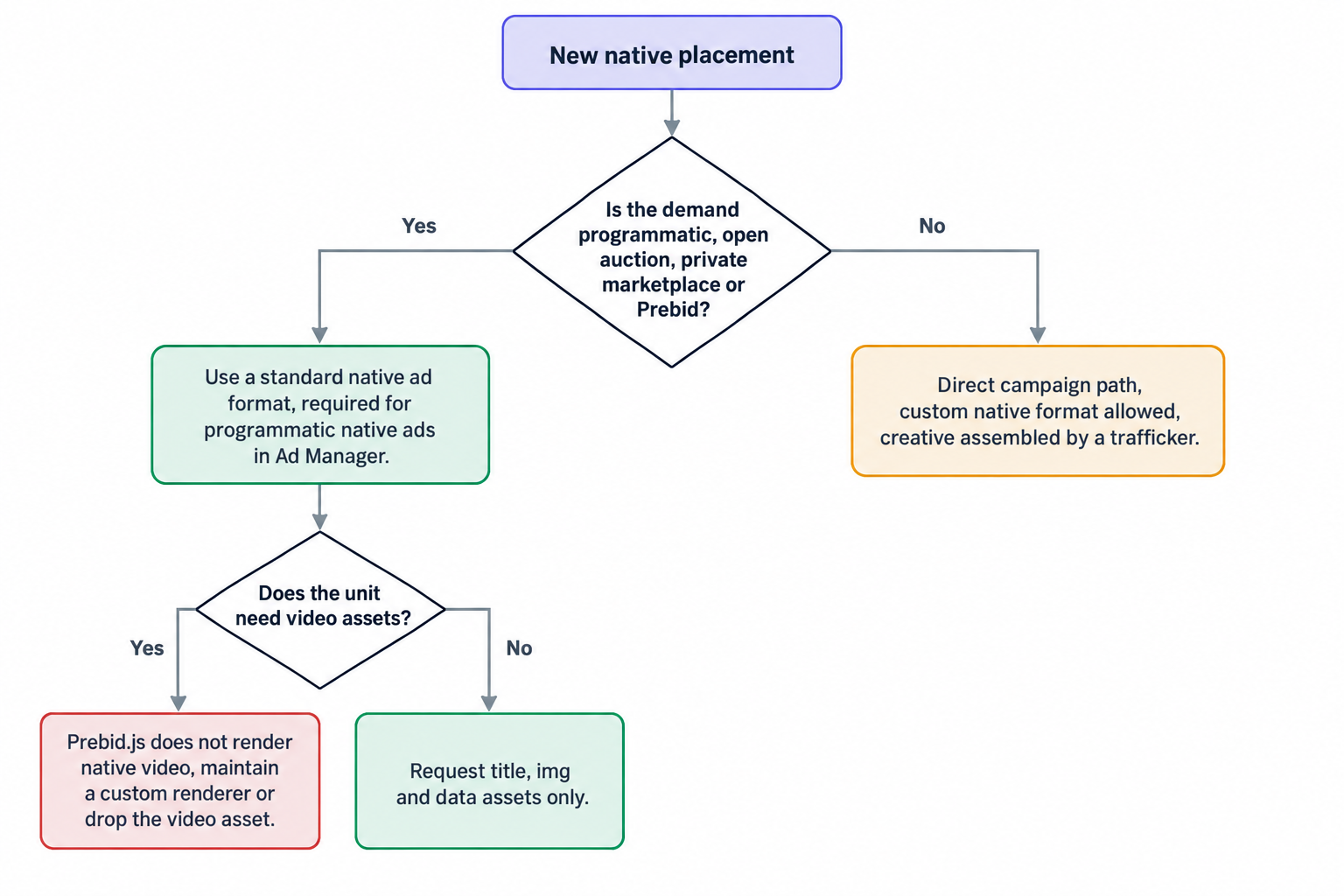
Google Ad Manager supports only standard native ad formats for programmatic native ads, and custom native formats serve direct campaigns. That constraint, documented under native ad formats in Ad Manager, decides your format architecture before you write a line of wrapper code.
Standard native formats map onto the same typed asset structure the OpenRTB spec defines: a headline, an image, a body or description, a sponsor, a call to action, a click URL. A well-chosen standard format covers nearly every programmatic native use case a publisher above one million monthly pageviews will run. Custom formats tempt teams with fields standard formats lack, but a custom format that only direct campaigns can serve does nothing for open auction yield, and it splits your creative QA across two systems.
On the trafficking side, standard native formats slot into the same line item machinery as display: price priority, open auction, private marketplace deals. Custom formats require per-campaign creative uploads, which is exactly why they belong with direct IOs and a human trafficker. The correct split is simple to state and takes discipline to hold: build programmatic native on standard formats, and reserve custom formats for guaranteed campaigns. When a direct unit performs well, rebuild it as a standard format variant and let programmatic demand compete for the pattern.
Two taxonomies, one unit
The IAB published the Native Advertising Playbook 2.0 on May 9, 2019, revising the taxonomy of native ad types it first laid out in December 2013. The playbook classifies native the way a reader encounters it, by surface and by relationship to surrounding content. The OpenRTB spec classifies native the way a machine consumes it: typed assets, declared constraints, agreed tracking. Neither replaces the other, and the gap between them is where most native operational confusion lives.
Close the gap with a mapping document. A portfolio above one million monthly pageviews typically runs native in three or four surfaces: an in-feed unit on index pages, an in-article unit between paragraphs, an end-of-article unit, sometimes a recommendation module. Give each surface one row that binds the placement name, the playbook category it follows, the Placement and Context values the imp.native request sends, the standard Ad Manager format it targets, and the renderer that paints it. When a new surface launches, the document turns a format debate into a single lookup. When a buyer reports render problems, the document tells you which of the four asset types failed and in which renderer.
The 2017 spec already contains the automation
The three additions in version 1.2 are the mechanics of a fully automated native market. Third-party ad serving lets a buyer's ad server carry the creative workload, so the ad can change without a new bid. Dynamic creative through URL responses lets a decisioning system assemble the unit at fetch time, from a product feed, a headline pool or a set of campaign parameters. Declared event tracking types move measurement into the request itself, so a buyer commits to its tracking before the auction runs instead of bolting trackers on afterwards. A spec that froze in 2017 already carries everything an automated buyer needs to run native without humans in the loop.
Third-party ad serving also changes what your renderer must tolerate. One response arrives as a complete asset array. Another resolves through a URL at render time. Test both paths, because a payload that resolves late and fails silently will read on the buy side as a placement that renders badly, not as an integration gap.
Measurement deserves its own audit. When the request declares event tracking types, viewability and click measurement become part of the deal rather than a post-render negotiation. Confirm what your request declares, then verify in your own reporting that rendered units fire the declared events. Automated buyers adjust bids to observed performance, so a unit that renders perfectly but tracks poorly prices like a bad placement, through no fault of the creative.
Native bids also live under the same auction regime as everything else. In a first-price auction with bid shading, a native bid competes on expected value against every display and video bid for the same impression, and your reserve price sets the floor under that competition. Because native render rates and buyer pools differ from display, set reserves per native placement instead of inheriting display floors. Our auction mechanics and reserve prices reference covers how expected-value ranking, first-price bids with bid shading, and reserve prices interact when native and display bids share one auction.
Server-side integration moves the auction, not the rendering. OnlyMedia integrates OpenRTB 2.6 seats and Prebid for header and server-side demand, and the native payload survives the hop intact: imp.native goes out, adm comes back, and the renderer still paints the unit in the browser. Server-side changes latency and demand reach, not the creative contract. Plan your renderers for a stack where the auction happens off page and the postMessage call happens on it.
Context signals gain weight as identifiers weaken. The spec deprecated LayoutID in favor of Placement and Context in 2017, and automated buyers increasingly key native decisions to page context rather than user identity. Fill both fields honestly and specifically. A request that names its surface and its surroundings gives a template-driven buyer the signals it needs; a vague request prices like an unknown.
What buyers automate against
Buy-side platforms assemble native creatives dynamically when the request declares its components cleanly, and major DSPs such as The Trade Desk, DV360 and Amazon DSP buy native against the OpenRTB asset array. The economics follow from the contract: a placement with precise declarations and a clean render history carries higher expected value, and higher expected value turns into higher bids. A placement that declares little and renders worse receives the same treatment in reverse, silently.
This is why curated supply paths matter more for native than for standard display. Curation lets a buyer trust the asset contract before the auction, which is the precondition for automating everything after the auction. On the demand side we reach buyers through verified audiences and curated supply paths, with OpenRTB 2.6 buying against native inventory that declares itself precisely. Your format discipline becomes visible as demand quality at exactly the moment buyers stop inspecting placements by hand.
Portfolio economics and payment discipline
Native does not stand outside the format portfolio; it competes inside it. The same page real estate holds every IAB display size plus in-stream, out-stream, interstitial and CTV video formats, and native has to win its share of impressions on expected value like the rest. Treat native as one competing bid source among the IAB display and video formats you already run, not as a separate channel with separate rules.
The revenue model around native rewards patience, and payment terms decide who can afford that patience. Native yield compounds as render quality improves and buyers learn which placements render reliably, and spend follows the learning. We are an ad network, an SSP and an agency in one company; we work with thousands of publishers, each above one million monthly pageviews, through our curated programmatic demand network; and we pay Net 30, CPM based, with no chasing and no sliding terms. A partner who stretches payment while that learning curve builds adds risk to the one revenue line that needs consistency most.
The operating checklist
A fully automated native operation is a set of habits rather than a product you buy. The work splits into audits you run once and checks you run continuously:
- Audit every imp.native declaration against what the renderer actually enforces: title limits, image aspect, data fields. Mismatched declarations cost money twice, in bid rate and in render failures.
- Standardize on standard native ad formats in Ad Manager for all programmatic demand, and keep custom formats behind direct IOs.
- Confirm the event tracking types your request declares, and verify that rendered units fire them in your reporting.
- Set per-placement native reserves instead of inheriting display floors, and revisit them when buyer pools shift.
- Test renderers on every viewport and on slow connections, because postMessage failures look like nothing in the bid response.
- Decide the video policy explicitly: Prebid.js does not render native video, so either maintain a renderer or ship title, img and data units.
- Keep the taxonomy mapping document current, one row per placement, from playbook category to renderer.
Run the audits quarterly and wire the continuous checks into monitoring. Most of what the market packages as native innovation will then reduce to work you already do.
What full automation actually rewards
The future of native in a fully automated programmatic world is not a new unit type. The asset contract froze in 2017, the playbook taxonomy froze in 2019, and the render path has been an HTML5 postMessage call inside an iframe for years. Two gaps define the next phase: Prebid.js does not render native video, and custom native formats remain out of reach for programmatic demand in Ad Manager. Whichever standards body or platform closes those gaps first changes the format calculus for everyone, but neither gap stops a publisher from executing well today.
Automation does not erase the differences between publishers. It moves those differences to the two places machines cannot fix for you: the request you send and the code that paints the response. Publishers who treat imp.native as a product specification, and their renderer as production code, will sell into automated demand at prices the vague and the careless cannot reach, and the gap will widen precisely because everything else now runs without a human in the loop.