The Ultimate Publisher's Guide to Google MCM

A child publisher inside Google Multiple Customer Management can hold one Manage Account delegation and up to 15 Manage Inventory delegations at the same time, and every one of those relationships starts with an invitation that expires after 90 days. The approval behind an accepted invitation usually takes a few days, but the process can take 2 to 4 weeks. The revenue share between parent and child is optional, configured per invitation anywhere from 0 to 100 percent. Those mechanics decide who sells your inventory, who collects Google's payment first and how fast a migration can move, and most publishers meet them for the first time inside a contract negotiation.
MCM is the framework inside Google Ad Manager 360 that lets one publisher, the parent, manage, represent or sell the inventory of another publisher, the child. It replaced Google's earlier SPM construct for third-party management, and Google frames its scope with a single rule: to monetize inventory you do not own and operate in Ad Manager, you have to use MCM. Any network, agency or SSP that sells your inventory through Google's stack does it under an MCM delegation, which means the inventory chain always has a visible, auditable head. Google's Manage Inventory documentation states the rule and walks through the delegation mechanics in depth.
The parent seat is a 360 product. Google offers MCM only in Ad Manager 360 for the managing publisher, so anyone parenting you holds a 360 license and the operational weight that implies. Both sides need an active Ad Manager account in good standing before a delegation can move, and Google caps the relationship per inventory: exactly one parent manages, represents or sells any given piece of child inventory. You can divide an estate across parents, but you cannot run one ad unit through two of them.
Underneath the admin structure sits a chain of accountability. The child owns the content and the domain; the parent owns the serving and the demand relationships; Google owns settlement and the identity layer that connects them through sellers.json. When a buyer questions a bid, the answer resolves to a named parent and a named child, and that traceability from page to payment is the entire point of the construct. Opaque reselling fails exactly that test, which is why the ads.txt requirements below carry real money.
The two delegation types
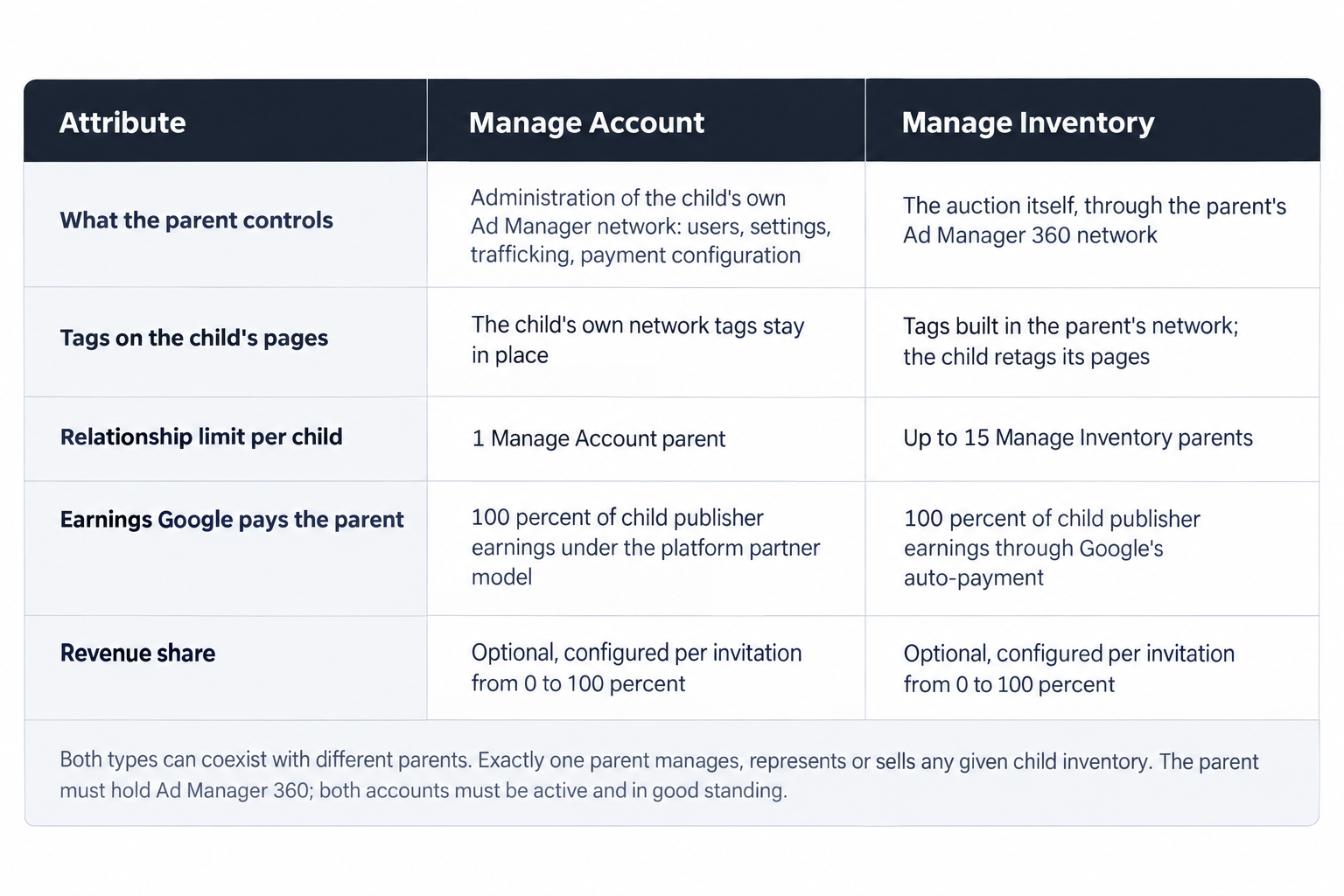
Google splits the parent-child relationship into two delegation types, and Google's MCM overview documents both, along with the parent limits and the payment mechanics. The types answer different operational questions: Manage Account delegates administration, Manage Inventory delegates the auction itself.
Manage Account hands the parent administrative control of the child's own Ad Manager network: user management, settings, trafficking, payment configuration. The child keeps its own tags on its pages and its own ad units, and the parent runs the account around them. Publishers choose this model when serving stays in house and platform work does not, or when the parent's 360 license gives access to demand and features the child's own tier cannot reach.
Manage Inventory moves the serving. The child retags its pages with tags built in the parent's 360 network, and the parent traffics, targets and sells the inventory as part of its own operation. The child's own Ad Manager steps back from serving, which makes this the model for full-service monetization rather than a managed account. The retagging work is the migration project, and the sections below treat it as one.
The two types coexist. A child publisher can hold one Manage Account delegation and up to 15 Manage Inventory delegations, each with a different parent, and large estates use exactly that shape: one agency parent administers the account while specialist parents run display, video or single-market inventory under Manage Inventory. The per-inventory exclusivity rule still binds the architecture. Split the estate across parents, never the ad unit.
The money: the split and the payment chain
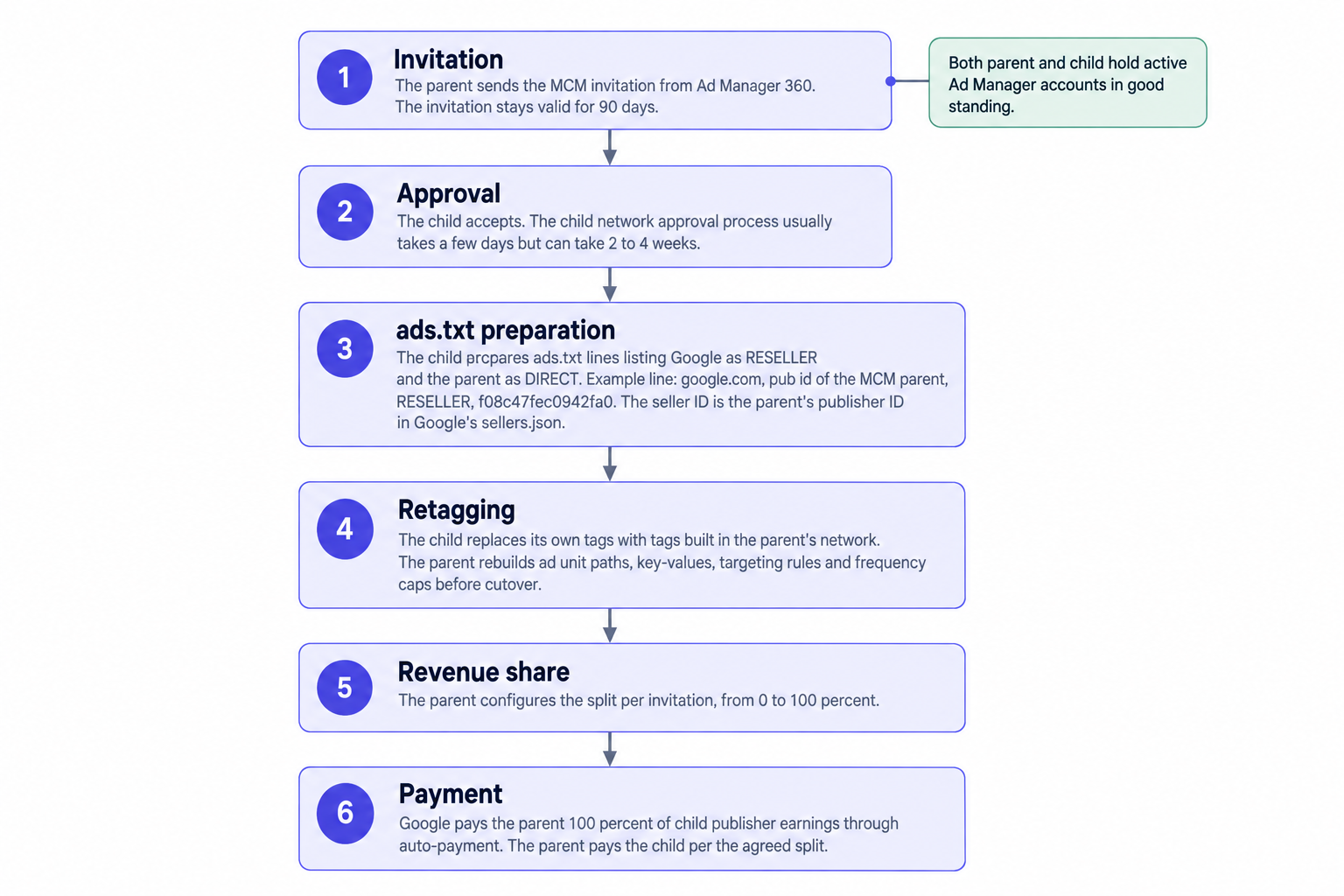
MCM leaves the commercials to the parties. The revenue share is an optional setting, and the parent configures it per invitation within a range of 0 to 100 percent. Both partner models Google documents collect the full amount at the parent first. Ad Manager 360 platform partners receive 100 percent of child publisher earnings under the platform partner model, and reseller partners receive 100 percent of the child publisher's earnings through Google's auto-payment. The child's share is then a private agreement, executed by the parent's finance team, on the parent's calendar. Because the parent configures each invitation separately, two children under the same parent can hold different terms on identical inventory.
Read that chain before you negotiate anything else. Google pays the parent, and the parent pays you, so your cash flow inherits the parent's invoicing habits. A parent that pays Net 30, CPM based, every month beats a parent quoting a higher headline split on open-ended terms. Ask for three numbers in writing: the revenue share percentage, the base it applies to, and the day count between invoice and cash. A split means nothing until all three sit next to each other.
The timeline: 90 days, then the approval window
An MCM invitation stays valid for 90 days, so treat it as a queue position rather than a deadline. Once the child accepts, the child network approval process usually takes a few days, but it can take 2 to 4 weeks. Plan against the slow case. Submit the invitation while your current setup still serves, then use the approval window to prepare the ads.txt lines, the tag migration plan and the reporting handover, so approval lands on a ready migration instead of starting one. Publishers who wait for approval before planning lose weeks they never needed to lose.
Manage Inventory mechanics: the retagging project
Retagging is the real work inside a Manage Inventory move. The child replaces its own Ad Manager tags with tags built in the parent's network, which means ad unit paths, key-values, targeting rules and frequency caps need rebuilding on the parent side before any cutover. Direct campaigns do not migrate by themselves: house deals, sponsorships and direct-sold reservations either move into the parent's 360 under new names or renegotiate into the parent's managed demand. Advertisers and agencies buying your inventory directly should learn the new structure before the swap, not after it.
Reporting inverts with the tags. Under Manage Inventory, the parent's network holds the serving data, and the child sees what the parent shares, so the reporting question belongs in the contract, not the post-mortem. Ad Manager 360 reports MCM children by name and publisher ID inside the parent's account, which makes demand analysis by child native on the parent side; insist that it reaches you too. Ask for the breakdown level (site, ad unit, geo, device, buyer) and the data latency. A disciplined parent answers before you have to ask twice.
ads.txt and sellers.json: the lines that authorize the chain
Every Manage Inventory child must host a valid ads.txt file, and that file decides whether buyers treat your inventory as authorized supply. The file lists Google as RESELLER and the managing parent as DIRECT, and Google's seller ID submission guidance prints the example line verbatim: google.com, pub id of the MCM parent, RESELLER, f08c47fec0942fa0. The seller ID in play is the publisher ID published in Google's sellers.json, so the chain audits publicly: your domain declares the parent's pub ID, and the parent's sellers.json entry declares who stands behind it.
Three failure modes break most migrations:
- The file carries the child's pub ID where the MCM parent's pub ID belongs. Google validates the parent's ID, not yours.
- The file keeps a stale parent pub ID after a change of parent, which deauthorizes the new chain while the old one is gone.
- The TAG ID f08c47fec0942fa0 goes missing or mistyped. Keep the full line exactly as Google prints it.
Sequence the file with the tags: publish the parent lines on the same day the parent tags go live, and review your declarations once the old serving stops. The same files double as due diligence before you sign. Pull the prospective parent's ads.txt and sellers.json entry, and check that the declarations resolve cleanly, because a parent with disordered files passes that disorder to every child domain it manages. The example line above shows what a clean declaration looks like on your side; the parent's side should look at least as tidy.
Where MCM sits inside a working stack
A delegation is only as good as the demand behind it. We run Google Ad Manager, AdX and MCM for our publisher partners, and the MCM seat sits inside a full stack rather than at the edge of one: OnlyMedia operates as an ad network, an SSP and an agency in the same company. Our SSP runs one unified auction per impression, with AdX through the MCM seat, Prebid demand across header and server-side, OpenRTB 2.6 seats and managed floors in front of the auction. A curation layer filters what reaches the seats: demand mapping, whitelists, pre-bid brand safety filtering and MFA filtering aligned with the IAB Content Taxonomy, so made-for-advertising inventory stays out of the bid stream. Buy-side platforms such as The Trade Desk, DV360 and Amazon DSP bid with more confidence on supply paths they can trace, which is the practical argument for curation ahead of the auction.
The paperwork runs on the same discipline. For teams connecting their own systems, our API documentation for OpenRTB and VAST integration covers the seat-level details. We pay Net 30, CPM based, no chasing and no sliding terms, and we work with thousands of publishers, each above one million monthly pageviews, the scale where a curated programmatic demand network earns its keep. Onboarding takes two to five days, and we evaluate new inventory from a traffic report in about two weeks, so testing us costs a fortnight, not a quarter. The publisher monetization side runs on the same terms, from curated demand through a reporting console that refreshes every ten minutes to Net 30 payments.
Choosing the delegation type
The delegation choice follows from what you want to keep. Keep trafficking, campaigns and direct relationships in house, and Manage Account fits: the parent administers, you serve. Hand the auction to a specialist, and Manage Inventory fits: the parent serves, and you publish the ads.txt lines and watch the reporting. Most large estates end up hybrid, one administrative anchor plus several inventory specialists, because the limits allow it and the exclusivity rule permits it.
Work through the decision in this order:
- What share of revenue is direct-sold? Direct campaigns cost the most to migrate, so a high share argues for Manage Account or a tightly planned migration.
- Who runs floors, brand safety and MFA policy? If nobody runs them in house, delegate the inventory and buy the curation with it.
- How many parents do you need? One Manage Account parent and up to 15 Manage Inventory parents leave room to specialize by format or market, one ad unit at a time.
The order matters because migrations compound: once the parent's tags are live, a second move costs another retagging project. Budget the second project before you sign the first contract.
What to verify before you sign
Run the same audit on every prospective parent, including ours. A term that never reaches the contract does not exist, no matter what the pitch deck says:
- The revenue share percentage, in writing, with the base it applies to.
- The payment terms: fixed Net 30 on CPM based earnings, or sliding terms that move with the month.
- The exact ads.txt lines you must publish, with the parent's pub ID, before any tag goes live.
- The reporting surface: which MCM dimensions you receive, at what granularity, with what latency.
- The exit path: who retags back, who rewrites the ads.txt, and how fast sellers.json follows the change.
- The demand behind the seat: AdX via MCM alone, or OpenRTB seats and Prebid across header and server-side.
- The curation standard: managed floors, demand mapping, whitelists, pre-bid brand safety filtering and MFA filtering aligned with the IAB Content Taxonomy.
Agencies advising a client should add one step before the commercial conversation: pull the parent's sellers.json and ads.txt, and read how the parent runs the rest of its estate. Disordered declarations at the parent predict disordered payments to the child.
MCM compresses into one paragraph once you see the structure: one Manage Account parent, up to 15 Manage Inventory parents, one parent per ad unit, a 90-day invitation, an approval window that can run 2 to 4 weeks, a split configured between 0 and 100 percent, and a payment chain that reaches the parent before it reaches you. Everything outside those mechanics is a private commercial term. OnlyMedia states its terms plainly: Net 30, CPM based payouts, onboarding in two to five days, and an inventory evaluation inside about two weeks of a traffic report. Hold every parent you meet to the same clock.