Why Generative AI is the Next Big Shift in Programmatic Ad Buying
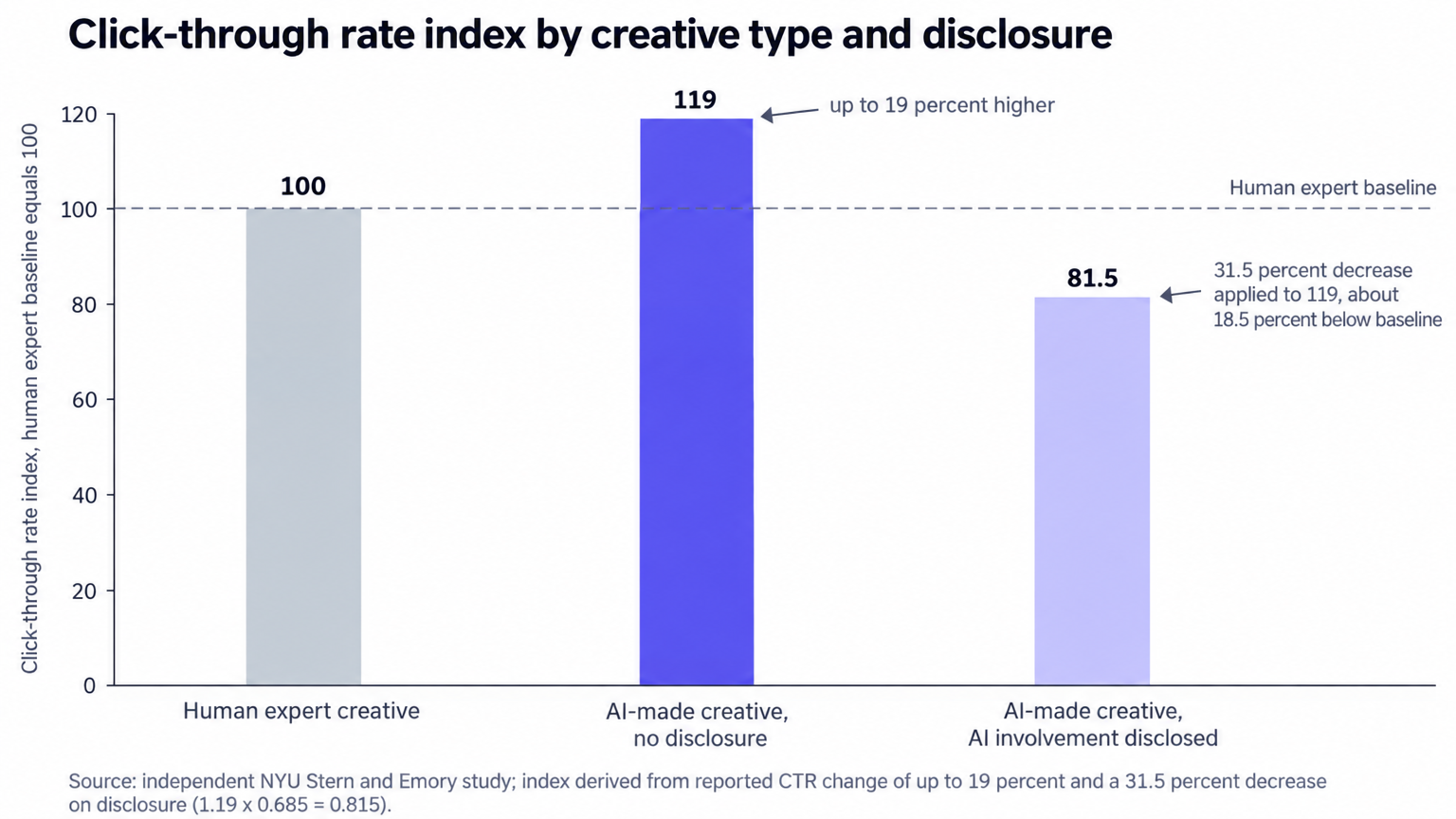
Ads built entirely by generative AI delivered click-through rates up to 19 percent higher than ads made by human experts, and disclosing that AI involvement caused a 31.5 percent decrease in click-through rates. An independent NYU Stern and Emory study produced both numbers, and together they define the next shift in programmatic buying more precisely than any product announcement: the cost of producing a working creative is collapsing, while disclosure rules claw back part of the gain. Every mechanism downstream now adjusts to those two forces, from auction density to package curation to the speed at which deals close.
The change already runs in production systems, not on a vendor roadmap. Google ships generative asset tools inside Demand Gen, its March 2026 announcement puts Gemini inside Display and Video 360, and the IAB Tech Lab agentic protocols, updated in September 2026, provide open-source agent SDKs for buyers and sellers. None of this waits on your migration plan. If you operate a site above one million monthly pageviews, the creative mix and the deal flow hitting your ad server will change materially within a few quarters, and teams that treat it as an operations problem will price it better than teams that treat it as a conference topic.
What the performance data actually says
The independent NYU Stern and Emory study compared ads made entirely by generative AI against ads made by human experts. The fully generated ads performed the best, with click-through rates rising by up to 19 percent. When the researchers disclosed AI involvement, click-through rates fell 31.5 percent. Multiply the two effects and a labeled AI ad lands roughly 18.5 percent below the human expert baseline, because 1.19 times 0.685 is about 0.815. The advantage and the penalty nearly cancel.
Two conclusions follow for anyone pricing inventory. The production gain is real: a 19 percent lift in click-through is a large effect for a single creative decision, and buyers will chase it wherever the law does not force a label. Where regulation does force one, buyers absorb a 31.5 percent response penalty, and rational media traders discount their bids against it. Generated creative will concentrate in formats and markets without labeling rules, and brands with strict disclosure policies will bid more selectively once labels reach their reporting.
The study also changes creative testing economics. A prompt produces an asset in seconds, so the marginal cost of another variant approaches zero and the number of variants per campaign rises accordingly. Testing that used to settle one question, which headline wins, now runs continuously across formats, product angles and pacing. Publishers should assume the creative arriving in their ad server changes faster than any quarterly review cycle can track.
The buy side rebuilds around generated assets
Google's Demand Gen campaign type documents the production tools in plain terms: they create new and original image assets from prompts and generate headlines and descriptions, with AI-content labeling required in regions with local AI labeling regulations. The vendor-reported performance numbers from Google's April 16, 2024 Demand Gen post push in the same direction: advertisers running both video and image ads saw 6 percent more conversions per dollar than advertisers running image-only, and adding product feeds drove 33 percent more conversions at similar cost per action.
Read those results as a production directive. A buyer who follows them runs more formats per line item, all generated from one prompt set and one product catalog. Because the marginal cost of another variant approaches zero, buyers can ship hundreds of assets where they once shipped a handful, and every one of those assets competes for the same impressions your pages serve.
Creative volume changes three things on your side of the pipe. Fill quality varies more, because generated assets run from excellent to sloppy and the weak ones concentrate in open supply where nobody curates. Session coherence degrades, because each impression can draw a different variant and the page experience depends on the weakest asset in the set. And manual creative review stops scaling: a team sampling creatives from a spreadsheet cannot inspect hundreds of variants per campaign per week, so creative classification has to become an automated job with sampled human verification.
Gemini in DV360 moves curation ahead of the ad
In its March 23, 2026 announcement, Google put Gemini inside Display and Video 360. Three features matter more than the model name. The Marketplace now proactively curates media packages before ads go live, which moves package assembly from a planner's spreadsheet to a machine step that runs before your inventory sees a single bid. An Ads Advisor assistant sits inside the campaign workflow. And Confidential Publisher Match aligns buyer data with publisher data without either side handing over raw user identifiers.
Google published performance figures with the announcement, and each deserves its label. A Circana marketing mix model meta-analysis of 3,212 United States campaigns from 2019 to 2025, commissioned by Google, found a 76 percent lift in return on ad spend when advertisers added one more Google Marketing Platform product. Google-internal data from February 2026 states that DV360 audience segments reach 96 percent of ad-supported CTV households. Treat the first as Google-commissioned and the second as Google-internal. Both support the same buyer behavior: spend consolidates through a single curation layer, and that layer decides which publishers get packaged.
For agencies advising publishers, the 76 percent figure is the pitch your clients will hear from the buy side: consolidate into one platform stack. The counter you can sell is provable package quality: clean inventory, consented audience data and metadata a model can parse without a human intermediary.
The CTV figure deserves a second read. When audience segments reach 96 percent of ad-supported CTV households, the curation layer stops thinking in individual sites and starts thinking in household-addressable supply. Publishers with strong video inventory should structure their metadata for that lens: content vertical, session context, device mix and consented audience attributes, all in machine-readable form.
Proactive curation rewrites the publisher's job description. When a human planner assembled packages, a good sales conversation could rescue weak metadata. When a model assembles packages, your inventory either parses cleanly or the model skips it. Consistent naming, accurate categories, reliable consent signals and a coherent audience description now function as inputs to a curation model, not as sales collateral.
The agentic layer turns deals into protocol
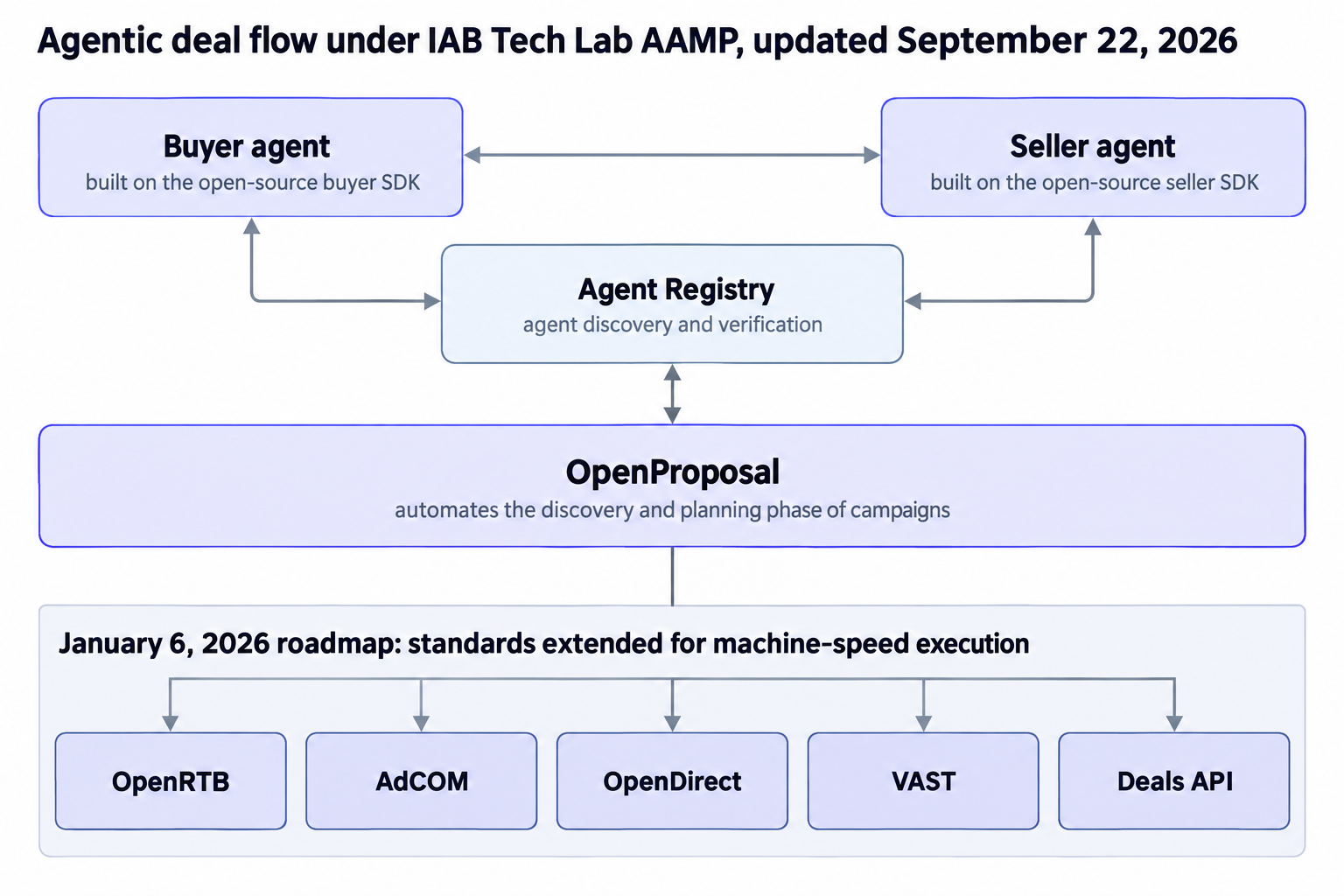
IAB Tech Lab updated its Agentic Advertising Management Protocols on September 22, 2026, and the update converts agentic buying from whitepaper into shipping code. The protocols provide open-source buyer and seller agent SDKs, an Agent Registry, and OpenProposal, which automates the discovery and planning phase of campaigns. A January 6, 2026 roadmap extends OpenRTB, AdCOM, OpenDirect, VAST and the Deals API so agents execute at machine speed across the standards your stack already speaks.
Map that against how deals close today. Discovery means emails and decks. Planning means a human picks packages from a list. Negotiation means a contract cycle measured in days. OpenProposal compresses the first two phases into protocol messages between a buyer agent and a seller agent, and the extended standards carry the agreed terms through the auction path without a human re-keying them. The publisher side of that exchange needs its own agent or, at minimum, an agent-readable description of what you sell, at what floor, with which audience claims.
The guarantee question matters most here. When OpenDirect and the Deals API carry machine-speed execution, a buyer agent can commit to volume and terms that look exactly like the guaranteed direct deals your sales team negotiates by hand. Our agency side brings direct budgets and guaranteed deals to the same inventory the exchange monetizes, so we watch those two channels converge from both directions. Publishers without a position on agent-negotiated guarantees will meet them first as a take-it-or-leave-it term sheet, not as a negotiation.
Buyers on our exchange already work at the protocol level: they reach us over OpenRTB 2.6, and our advertisers page documents the demand side reach, verified audiences and curated supply paths they buy against. When buyer agents start probing supply paths programmatically, curated paths with honest metadata will answer faster than undifferentiated open supply, and the Agent Registry will make it obvious which sellers cannot answer at all.
What machine-speed demand does to your auction
Bid density is the variable to watch. First-price auctions with bid shading calibrate to the number of bidders an impression attracts, and agentic demand adds participants that evaluate, shade and pace in real time rather than in daily optimization cycles. Reserve prices set for the old rhythm clear too cheaply or too rarely under the new one. Expected-value ranking absorbs some of the shock: an exchange that scores bids on realized value rather than face value gives low-quality generated-creative bids no structural advantage over buyers whose money actually arrives.
Run the floor test against current bid density, not last quarter's. Our auction mechanics and reserve prices documentation covers the specifics: expected-value ranking, first-price with bid shading, and the reserve price logic behind every auction we run. The point for your team is procedural: agentic demand changes the shape of the bid stream, and a floor review triggered by a calendar date instead of by bidder-count changes will misprice your best slots.
Labels arrive at serving time
The disclosure layer is concrete, not speculative. The Display and Video 360 API lets buyers disclose assets as AI-generated or AI-edited, and the platform applies labels at serving in regions with AI labeling regulations. Demand Gen documentation requires AI-content labeling in regions with local AI labeling regulations under the same logic. Where a rule exists, the label ships with the ad, and the NYU Stern and Emory result, a 31.5 percent decrease in click-through, tells you how audiences respond when they see it.
Publishers need a position on labeled creative, and ignoring the flag stops working the moment labels reach your markets. Split reporting by disclosed creative once your partners pass the flag, because that performance gap belongs in package pricing conversations. Set a quality bar for generated creative inside any curated or guaranteed product you sell: a 31.5 percent response penalty is a package-level risk, not only the buyer's problem. And keep the 19 percent result in view while you set the bar, because generated creative is not inherently bad and a blanket ban hands the economics to publishers who manage the variance instead of refusing it.
What to do in your stack this quarter
The shift compounds across creative, curation, deals and disclosure, so the response has to span all four. This list reflects the order we would sequence the work for a publisher above one million monthly pageviews, and agencies advising several publishers can run it as a shared audit across their roster.
- Clean the inventory taxonomy. Slot names, section names and content categories should read as one coherent system, because curation models and buyer agents parse them before any human reads a proposal.
- Structure first-party data for matching. Confidential Publisher Match rewards publishers who can describe their audiences in consented, structured form; raw traffic volume matches nothing.
- Automate creative classification. Classify at the creative level by format, declared AI status and measured engagement, with sampled human verification, because manual review cannot keep pace with hundreds of variants per campaign.
- Re-run reserve price tests. Floors calibrated to yesterday's bidder count leave money on one side or the other, so trigger the test on bidder-count changes rather than on the calendar.
- Assign an owner to the agentic standards. Someone on the team should read the AAMP buyer and seller SDKs and decide when a seller agent makes sense, because the Agent Registry will not populate itself.
- Draft the disclosure policy before labels arrive in your markets. A position written under deadline pressure costs more than one written now, and the 31.5 percent number gives you the internal business case.
None of this requires new headcount. Each item converts a task your team already performs manually into something a machine can query, and that conversion is the direction the buy side has already taken. The sell side does not get the option to abstain; it only gets the option to arrive early or late.
Where we sit in this shift
OnlyMedia runs an ad network, an SSP and an agency in one company, so this shift reaches us from both ends of the pipe. We work with thousands of publishers, each above one million monthly pageviews, and we pay Net 30, CPM based: no chasing, no sliding terms. A machine-curated package and a hand-negotiated direct deal compete for identical impressions in front of us every day, which is why we treat the study numbers, the labeling rules and the agentic protocols as operating details rather than talking points.
The about page covers who we are in more depth: the expected-value auctions, the honest pricing and the reporting both sides trust. If you run inventory that deserves a curation model's attention instead of its indifference, our curated programmatic demand network is where that work starts. Generative AI changes what gets produced, how packages form and who negotiates the deal; publishers who make their inventory legible to machines will set the terms agents negotiate later, and everyone else will accept them.